8.4. The List Interface (ADT)
A common ADT is the List interface. When thinking of a List as an abstract type, you can think of a List as an ordered collection of objects (no need to think specifically about the underlying data structure when discussing the ADT). There are several important operations (abstract methods) needed for a List. Some common list operations include, but are not limited to:
8.4.1. Common List Operations
Here is a list of common operations for a list:
Create a new list.
Retrieve an object in the list at a particular index.
Add an object to the list at a particular index.
Remove an object from the list at a particular index.
Clear the list.
Count the elements in the list.
Produce a string representation of the list's contents.
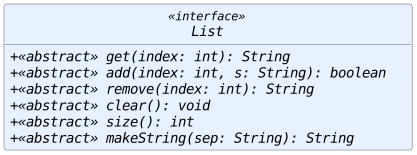
In this chapter, we use a custom List interface for strings, distinct from
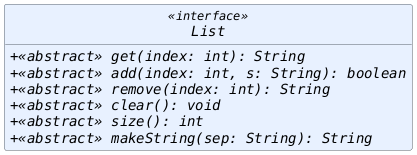
java.util.List. The UML diagram below summarizes its six public abstract
methods; the table describes their behavior.
Fig. 8.4 The six public abstract methods of this chapter's List interface. [svg] [png]
Return Type |
Method / Operation Name and Parameters |
Description |
|---|---|---|
|
|
Returns with the reference value stored
at the specified index. Throws
|
|
|
Inserts the reference value stored in
|
|
|
Removes the reference value at the specified index and returns with that value. Shifts subsequent reference values one position to the left. |
|
|
Removes all elements from the list. On normal completion, the method returns without a value and the list is empty. |
|
|
Returns with the number of elements in the list. |
|
|
Returns with a reference to a |
Creating a list is the responsibility of an implementing class, such as
ArrayBasedList or LinkedBasedList. Their no-argument constructors create
empty lists. The List interface itself does not declare a constructor.
8.4.2. What does the ADT not describe?
It doesn't describe how the operations work internally (the code in the methods). One list implementation might use an array to store the items in the list, while another list implementation might use a linked list to do the same. That is, different implementing classes are responsible for the inner workings of their implementations so long as the list operations work as previously described. The complete ADT will also describe what should happen under exceptional circumstances.
Test Yourself
In the example below, we provide a few List ADT method calls. It is
worth highlighting again that we can understand this code without
knowing any details of the underlying implementation. Using the table
above where needed, trace through the code below and write the output
you would expect to see after the last three println statements
execute.
We recommend writing the list out as you would a regular shopping list. You don't need to draw it as an array or a linked list. Just keep up with the items in the list and make sure they are in the right index (line).
List myList = new ArrayBasedList(); // or LinkedBasedList()
myList.add(0, "Bread");
myList.add(0, "Cheese");
myList.add(1, "Milk");
myList.add(3, "Ice Cream");
System.out.println("Removed: " + myList.remove(0));
System.out.println("List Size: " + myList.size());
System.out.println("List Contents: " + myList.makeString(","));
Test Yourself Solution (Open after attempting the question above)
Program Output:
Removed: Cheese
List Size: 3
List Contents: Milk, Bread, Ice Cream
Rapid Fire Review
What is a key feature of the List interface (ADT)?
It defines the internal storage method for a list.
It describes operations for an ordered collection of objects.
It defines how exceptions should be handled internally.
It guarantees that lists use arrays for storage.
Which of the following methods retrieves an object from a list at a specific index?
get(int index)add(int index, String s)remove(int index)makeString(String sep)
What happens when the
add(int index, String s)method is called on aList?The specified object is inserted at the end of the list regardless of the index.
The object at the specified index is replaced by the new object.
The object is inserted at the specified index, and subsequent objects are shifted to the right.
The list is cleared, and the specified object is added at the specified index.
What is the output of the code below:
List myList = new LinkedBasedList();
myList.add(0, "Bread");
myList.add(0, "Cheese");
myList.add(2, "Candy");
myList.add(2, "Milk");
myList.remove(2);
System.out.println("The item at index 2 is: " + myList.get(2));
System.out.print(" List Size: " + myList.size());
System.out.print(" List Contents: " + myList.makeString(", "));
The item at index 2 is: Candy List Size: 3 List Contents: Cheese, Bread, Candy
The item at index 2 is: Milk List Size: 3 List Contents: Cheese, Bread, Milk
The item at index 2 is: Candy List Size: 2 List Contents: Bread, Cheese
The item at index 2 is: Cheese List Size: 2 List Contents: Cheese, Bread
What is the difference between the
Listinterface and its implementing classes?The List interface defines how the data is stored, while implementing classes provide methods for list operations.
The List interface describes the methods for list operations, while implementing classes define the internal structure of how the data is stored.
The List interface requires the use of arrays, while implementing classes can use different data structures.
There is no difference between the List interface and its implementing classes.