9.6. Additional Practice Exercises
9.6.1. Code Tracing
Part 1
Use the UML diagram below to answer the questions in this section:
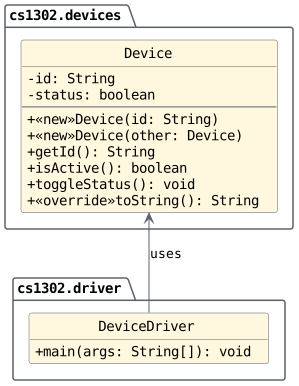
Implement a copy constructor for Device. (Note: Copy
idandstatusfrom anotherDevice.)Solution
// inside Device.java
public Device(Device other) {
    this.id = other.id;       // private but accessed within same class
    this.status = other.status;
} // Device
Implement
toggleStatus()to flip status betweentrueandfalse.Solution
// inside Device.java
public void toggleStatus() {
    status = !status;   // flips true <-> false
} // toggleStatus
Answer the questions below about the following code:
 1package cs1302.driver;
 2
 3import cs1302.devices.Device;
 4
 5/**
 6 * Demonstrates usage of the {@code Device} class.
 7 */
 8public class DeviceDriver {
 9
10    /**
11     * The entry point of the program.
12     *
13     * @param args command-line arguments
14     */
15    public static void main(String[] args) {
16        Device d1 = new Device("Router1");
17
18        // 1. Try direct access to status
19        d1.status = true; // LINE 1
20
21        // 2. Call toggleStatus
22        d1.toggleStatus(); // LINE 2
23        System.out.println(d1);
24
25        // 3. Create new Device using copy constructor
26        Device d2 = new Device(d1); // LINE 3
27        System.out.println(d2);
28    } // main
29} // DeviceDriver
Will
LINE 1compile?Solution
LINE1fails —statusis private, so external code (outsideDevice) cannot touch it directly.Will
LINE 2compile?Solution
LINE2 compiles.
toggleStatus()is public and exposes a safe way to change the internal stateCan
DeviceDrivercreate a copy using LINE 3?Solution
LINE3compiles. The copy constructor is public, soDeviceDrivercan use it.
Part 2
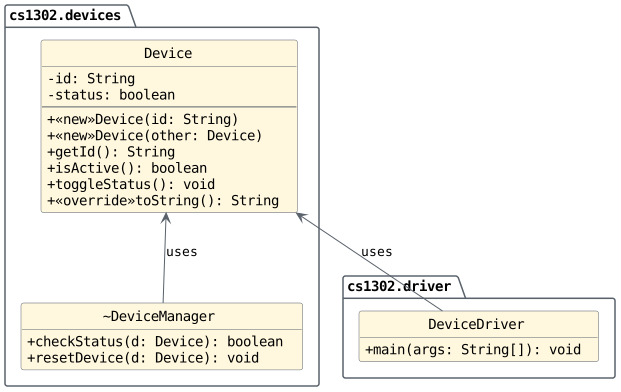
Use the UML diagram below to answer the questions in this section:
Answer the questions below about the following code:
 1package cs1302.driver;
 2
 3import cs1302.devices.Device;
 4import cs1302.devices.DeviceManager; // <-- LINE 1
 5
 6/**
 7 * Demonstrates usage of the {@code Device} and {@code DeviceManager} classes.
 8 */
 9public class DeviceDriver {
10
11   /**
12    * The entry point of the program.
13    *
14    * @param args command-line arguments
15    */
16    public static void main(String[] args) {
17       Device d1 = new Device("Router1");
18
19       // Use DeviceManager here:
20       DeviceManager dm = new DeviceManager(); // <-- LINE 2
21       dm.resetDevice(d1); // <-- LINE 3
22    } // main
23} // DeviceDriver
Can we import
DeviceManagerinDeviceDriver(LINE 1)?Solution
No.
DeviceManageris package-private, so it is not visible outsidecs1302.devices. The compiler will give the following error:error: DeviceManager is not public in cs1302.devices; cannot be accessed from outside package
Can we create a
DeviceManagerobject inDeviceDriver(LINE 2)?Solution
No. Since the class itself is not visible, its constructor isn't visible either. The compiler won't even recognize
DeviceManager.Can we call
resetDevice(d1)on aDeviceManagerobject fromDeviceDriver(LINE 3)?Solution
No, for the same reason. Even though
resetDeviceis public, it belongs to a package-private class. The class itself must first be visible, which it is not.Where can
DeviceManagerbe used?Solution
Only in the same package
cs1302.devices. For example, if we hadTestDeviceManager.javainsidecs1302.devices, it could useDeviceManagerwithout issues.
Part 3
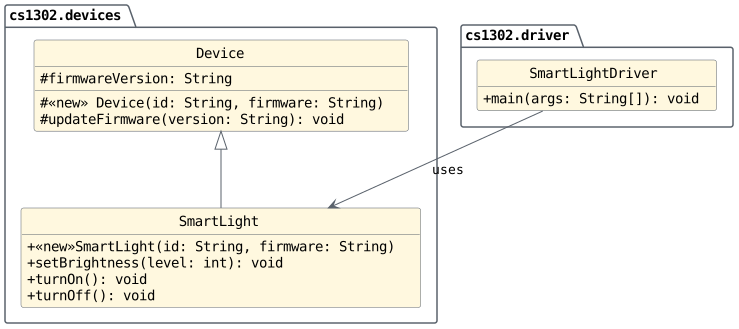
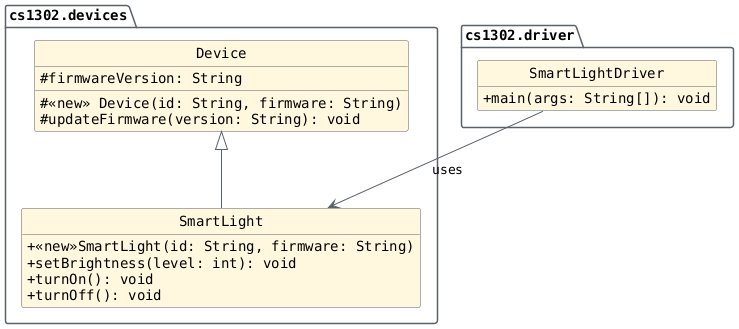
Consider the UML below where we add another class SmartLight
that extends Device and uses protected members.
Implement the
SmartLightconstructor to call the protectedDeviceconstructor.Solution
1public SmartLight(String id, String firmware) {
2    super(id, firmware);
3    this.brightness = 0;
4    this.isOn = false;
5
6    this.firmwareVersion = firmware; // optional: setting inherited field
7} // SmartLight
Can
SmartLightaccess the protectedfirmwareVersion?Solution
Yes. Subclasses have access to protected members of their parent class.
this.firmwareVersion = firmware;
In
SmartLightDriver, can we calllight.updateFirmware("1.1.0")?Solution
No. Protected members are not visible to classes in a different package unless they are subclasses.
SmartLightDriveris neither in the same package nor a subclass.Can
SmartLightDrivercalllight.turnOn()?Solution
Yes.
turnOn()is public, so accessible anywhere.Why can
SmartLightaccessupdateFirmware()butSmartLightDrivercannot?Solution
Protected members are accessible to subclasses.
SmartLightis a subclass of Device, so it can useupdateFirmware().SmartLightDriveris not a subclass and is in a different package, so it cannot access protected members.
9.6.2. Parsons Problems
Review these sections as needed:
Each problem specifies the caller's class and package and the relevant visibilities. Preserve those declarations unless the prompt explicitly asks you to choose one. Use every correct block once and leave incorrect blocks unused. Arrange blocks vertically and set their indentation; each level represents four spaces. Keep indentation within a block unchanged.
The text version supports solving on paper or without JavaScript. Letters identify whole blocks. Attempt each problem before opening its sample solution. A solution must satisfy the stated visibility requirements as well as compile and produce the required behavior.
The problems use two versions of Book:
Problems 1–3 use the simplified
Bookwhose superclass isObject.Problems 4–8 use
Book extends Product.
Each problem repeats the context needed to solve it independently.
The UML diagrams show only the declarations relevant to each problem;
+ denotes public visibility and ~ denotes package private visibility
for the top-level classes shown.
Problem 1: Declare Private State and a Public API
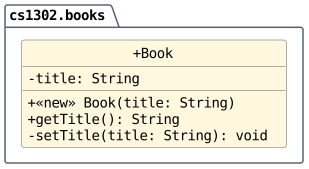
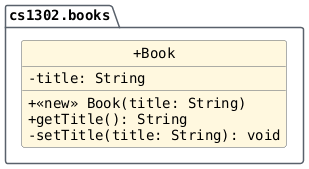
Use the simplified Book class shown below. Its superclass is
Object. The diagram specifies the required visibilities.
Source file: cs1302/books/Book.java
Assemble Book.java with the specified visibilities. Code in another
package must be able to construct a book and call getTitle(), but must
not access title directly. Keep each supplied declaration intact.
The instance variable, constructor, and methods may appear in any order
inside the class; the grader accepts those orders.
Text version of Visibility Problem 1
Use the simplified Book class shown below. Its superclass is
Object. The diagram specifies the required visibilities.
Source file: cs1302/books/Book.java
Assemble Book.java with the specified visibilities. Code in another
package must be able to construct a book and call getTitle(), but must
not access title directly. Keep each supplied declaration intact.
The instance variable, constructor, and methods may appear in any order
inside the class; the grader accepts those orders.
Write the letters of the correct blocks in order and give each block an indentation level. Leave incorrect blocks unused and preserve relative indentation within each block.
Block A
package cs1302.books;

/** A book used to demonstrate private access and reference values. */
public class Book {
Block B
/**
* Replace the stored title reference value.
* @param title the new title reference value
*/
private void setTitle(String title) {
this.title = title;
} // setTitle
Block C
} // Book
Block D
/** Reference to this book's title string. */
private String title;
Block E
/**
* Obtain the stored title reference value.
* @return the title reference value
*/
public String getTitle() {
return this.title; // return with the title reference value
} // getTitle
Block F
/** Reference to this book's title string. */
public String title;
Block G
/**
 * Initialize a book with the supplied title reference value.
 * @param title reference to the title string
 */
public Book(String title) {
    super();
    this.setTitle(title);
} // Book
Block H
package cs1302.books;
/** A book used to demonstrate private access and reference values. */
class Book {
Text version of Visibility Problem 1
Use the simplified Book class shown below. Its superclass is
Object. The diagram specifies the required visibilities.
Source file: cs1302/books/Book.java
Assemble Book.java with the specified visibilities. Code in another
package must be able to construct a book and call getTitle(), but must
not access title directly. Keep each supplied declaration intact.
The instance variable, constructor, and methods may appear in any order
inside the class; the grader accepts those orders.
Write the letters of the correct blocks in order and give each block an indentation level. Leave incorrect blocks unused and preserve relative indentation within each block.
Block A
package cs1302.books;
/** A book used to demonstrate private access and reference values. */
public class Book {
Block B
/**
* Replace the stored title reference value.
* @param title the new title reference value
*/
private void setTitle(String title) {
this.title = title;
} // setTitle
Block C
} // Book
Block D
/** Reference to this book's title string. */
private String title;
Block E
/**
 * Obtain the stored title reference value.
 * @return the title reference value
 */
public String getTitle() {
    return this.title; // return with the title reference value
} // getTitle
Block F
/** Reference to this book's title string. */
public String title;
Block G
/**
* Initialize a book with the supplied title reference value.
* @param title reference to the title string
*/
public Book(String title) {
super();
this.setTitle(title);
} // Book
Block H
package cs1302.books;
/** A book used to demonstrate private access and reference values. */
class Book {
Sample solution for Visibility Problem 1
Block order: A, D, G, E, B, C.
Indentation levels: 0, 1, 1, 1, 1, 0.
package cs1302.books;
/** A book used to demonstrate private access and reference values. */
public class Book {
/** Reference to this book's title string. */
private String title;
/**
* Initialize a book with the supplied title reference value.
* @param title reference to the title string
*/
public Book(String title) {
super();
this.setTitle(title);
} // Book
/**
* Obtain the stored title reference value.
* @return the title reference value
*/
public String getTitle() {
return this.title; // return with the title reference value
} // getTitle
/**
 * Replace the stored title reference value.
 * @param title the new title reference value
 */
private void setTitle(String title) {
    this.title = title;
} // setTitle
} // Book
The public top-level class and public constructor and accessor allow callers
in another package to create a book and read its title reference value.
The package private class alternative prevents that use from another package.
The public instance variable alternative compiles, but violates the required
private visibility: it would allow callers to change title directly.
The private setTitle method is accessible from the constructor because
both declarations occur in Book. The getter returns with the reference
value stored in title, not with a copy of the String object.
Problem 2: Copy a Title Inside Book
Work inside the simplified Book class shown below. Its superclass
is Object. This exercise adds the copy constructor shown in the diagram.
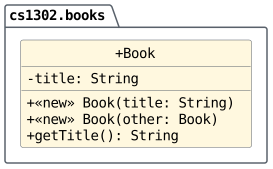
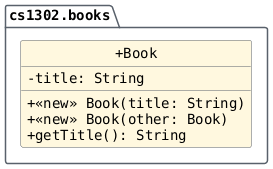
The argument supplied for other is a reference to a book whose title
is "LOTR".
Source file: cs1302/books/Book.java
Assemble the copy constructor. Explicitly call super(), then copy the
reference value stored in the other book's title instance variable into
this book's title instance variable. Do not create a new String object
or modify the other book.
Text version of Visibility Problem 2
Work inside the simplified Book class shown below. Its superclass
is Object. This exercise adds the copy constructor shown in the diagram.
The argument supplied for other is a reference to a book whose title
is "LOTR".
Source file: cs1302/books/Book.java
Assemble the copy constructor. Explicitly call super(), then copy the
reference value stored in the other book's title instance variable into
this book's title instance variable. Do not create a new String object
or modify the other book.
Write the letters of the correct blocks in order and give each block an indentation level. Leave incorrect blocks unused and preserve relative indentation within each block.
Block A
} // Book
Block B
/**
 * Copy another book's title reference value.
 * @param other non-null reference to a book object
 */
public Book(Book other) {
Block C
super();
Block D
this.title = other.title;
Block E
this.title = this.title;
Sample solution for Visibility Problem 2
Block order: B, C, D, A.
Indentation levels: 0, 1, 1, 0.
/**
 * Copy another book's title reference value.
 * @param other non-null reference to a book object
 */
public Book(Book other) {
super();
this.title = other.title;
} // Book
Private access is determined by where the access occurs, not by which
object is involved. Both this.title and other.title are accessible
inside Book. The assignment copies a reference value: the two distinct
book objects then refer to the same title string through their instance
variables. The alternative assignment only copies the new book's initial
null value back into its own title variable; it compiles but fails to
copy the other book's title.
Problem 3: Read a Title from BookDriver
Place this main method in BookDriver. The simplified Book
shown here has Object as its superclass.
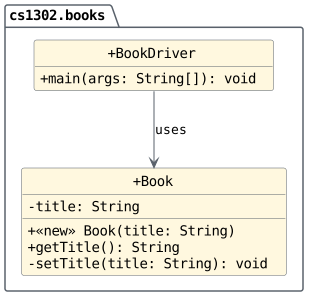
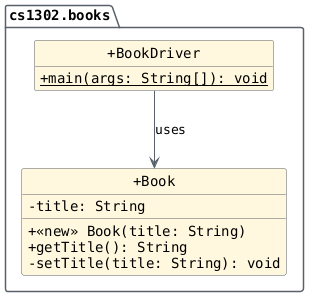
Source file: cs1302/books/BookDriver.java
Create a book with title "LOTR", read its title reference value into
title, then print that value. Preserve Book's existing visibilities.
Text version of Visibility Problem 3
Place this main method in BookDriver. The simplified Book
shown here has Object as its superclass.
Source file: cs1302/books/BookDriver.java
Create a book with title "LOTR", read its title reference value into
title, then print that value. Preserve Book's existing visibilities.
Write the letters of the correct blocks in order and give each block an indentation level. Leave incorrect blocks unused and preserve relative indentation within each block.
Block A
} // main
Block B
String title = book.getTitle();
Block C
Book book = new Book("LOTR");
Block D
System.out.println(title);
Block E
String title = book.title;
Block F
/**
 * Demonstrate visibility using the supplied arguments.
 * @param args command-line arguments
 */
public static void main(String[] args) {
Sample solution for Visibility Problem 3
Block order: F, C, B, D, A.
Indentation levels: 0, 1, 1, 1, 0.
/**
 * Demonstrate visibility using the supplied arguments.
 * @param args command-line arguments
 */
public static void main(String[] args) {
Book book = new Book("LOTR");
String title = book.getTitle();
System.out.println(title);
} // main
BookDriver can call the public getTitle() method on the accessible
public Book class. That method returns with the title reference value;
title stores that value, and the output is LOTR. Being in the same
package does not permit BookDriver to access Book's private instance
variable. The direct-access alternative produces a compile-time error.
Problem 4: Call a Package Private Method
Place this main method in InventoryDriver, with
import cs1302.books.Book; already present.
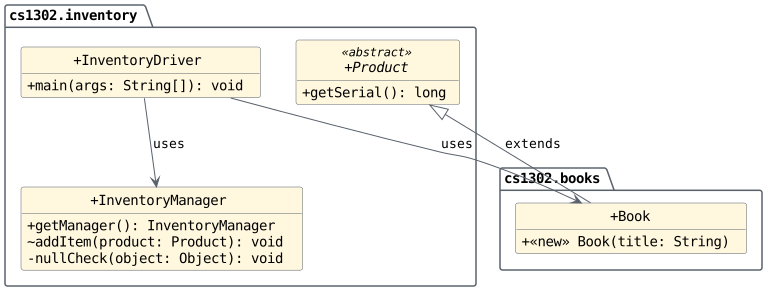
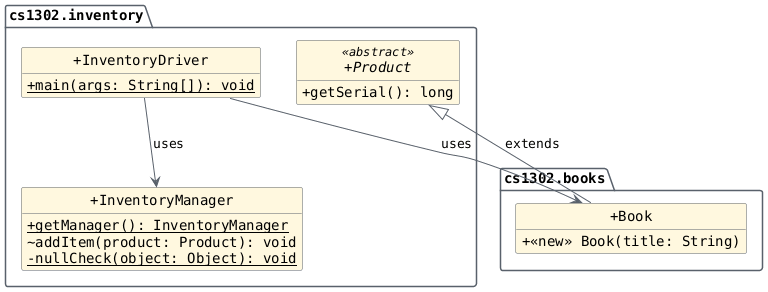
addItem checks its argument and sets the supplied product's serial
number to 15. nullCheck only rejects a null argument value.
Source file: cs1302/inventory/InventoryDriver.java
Obtain a manager and create a book, then call addItem to set that
book's serial number. Print the resulting serial number, 15. Keep all
existing visibilities unchanged.
Text version of Visibility Problem 4
Place this main method in InventoryDriver, with
import cs1302.books.Book; already present.
addItem checks its argument and sets the supplied product's serial
number to 15. nullCheck only rejects a null argument value.
Source file: cs1302/inventory/InventoryDriver.java
Obtain a manager and create a book, then call addItem to set that
book's serial number. Print the resulting serial number, 15. Keep all
existing visibilities unchanged.
Write the letters of the correct blocks in order and give each block an indentation level. Leave incorrect blocks unused and preserve relative indentation within each block.
Block A
InventoryManager manager = InventoryManager.getManager();
Book book = new Book("LOTR");
Block B
/**
 * Demonstrate visibility using the supplied arguments.
 * @param args command-line arguments
 */
public static void main(String[] args) {
Block C
manager.addItem(book);
Block D
System.out.println(book.getSerial());
Block E
} // main
Block F
InventoryManager.nullCheck(book);
Text version of Visibility Problem 4
Place this main method in InventoryDriver, with
import cs1302.books.Book; already present.
addItem checks its argument and sets the supplied product's serial
number to 15. nullCheck only rejects a null argument value.
Source file: cs1302/inventory/InventoryDriver.java
Obtain a manager and create a book, then call addItem to set that
book's serial number. Print the resulting serial number, 15. Keep all
existing visibilities unchanged.
Write the letters of the correct blocks in order and give each block an indentation level. Leave incorrect blocks unused and preserve relative indentation within each block.
Block A
InventoryManager manager = InventoryManager.getManager();
Book book = new Book("LOTR");
Block B
/**
* Demonstrate visibility using the supplied arguments.
* @param args command-line arguments
*/
public static void main(String[] args) {
Block C
manager.addItem(book);
Block D
System.out.println(book.getSerial());
Block E
} // main
Block F
InventoryManager.nullCheck(book);
Sample solution for Visibility Problem 4
Block order: B, A, C, D, E.
Indentation levels: 0, 1, 1, 1, 0.
/**
* Demonstrate visibility using the supplied arguments.
* @param args command-line arguments
*/
public static void main(String[] args) {
InventoryManager manager = InventoryManager.getManager();
Book book = new Book("LOTR");
manager.addItem(book);
System.out.println(book.getSerial());
} // main
InventoryDriver and InventoryManager share a package, so the
package private addItem method is accessible from this caller. Its
Java declaration has no access modifier; UML denotes this visibility with
~. The private nullCheck alternative produces a compile-time error:
sharing a package does not permit access to that private method. The two
initializations share a block because either could occur first.
Problem 5: Use a Public Method of a Package Private Class
Use the Utility class shown below.
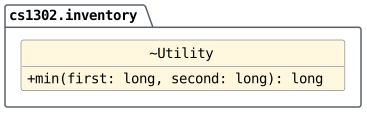
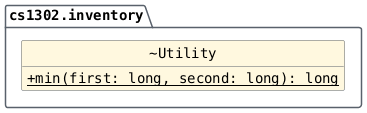
min returns with the smaller value. No other Utility class is
available. The supplied alternative package block includes an import,
so its failure concerns accessibility rather than a missing import.
Source file: cs1302/inventory/UtilityDriver.java
Assemble UtilityDriver.java to print 14 using Utility.min.
Choose the caller's package so that access is permitted. Do not change
Utility or add imports.
Text version of Visibility Problem 5
Use the Utility class shown below.
min returns with the smaller value. No other Utility class is
available. The supplied alternative package block includes an import,
so its failure concerns accessibility rather than a missing import.
Source file: cs1302/inventory/UtilityDriver.java
Assemble UtilityDriver.java to print 14 using Utility.min.
Choose the caller's package so that access is permitted. Do not change
Utility or add imports.
Write the letters of the correct blocks in order and give each block an indentation level. Leave incorrect blocks unused and preserve relative indentation within each block.
Block A
/** Demonstrates visibility from the chosen package. */
public class UtilityDriver {
Block B
} // UtilityDriver
Block C
/**
 * Demonstrate visibility using the supplied arguments.
 * @param args command-line arguments
 */
public static void main(String[] args) {
long smaller = Utility.min(14, 15);
System.out.println(smaller);
} // main
Block D
package cs1302.inventory;
Block E
package cs1302.books;
import cs1302.inventory.Utility;
Sample solution for Visibility Problem 5
Block order: D, A, C, B.
Indentation levels: 0, 0, 1, 0.
package cs1302.inventory;
/** Demonstrates visibility from the chosen package. */
public class UtilityDriver {
/**
 * Demonstrate visibility using the supplied arguments.
 * @param args command-line arguments
 */
public static void main(String[] args) {
    long smaller = Utility.min(14, 15);
    System.out.println(smaller);
} // main
} // UtilityDriver
The correct caller is in cs1302.inventory, where the package private
Utility class is accessible. Its public static method can then be
called as Utility.min(14, 15). The alternative places the caller in
cs1302.books and tries to import Utility. That import and use
produce compile-time errors: a public method does not make its declaring
class accessible from another package.
Problem 6: Obtain a Manager with a Private Constructor
Place this main method in ManagerDriver. It imports
InventoryManager from cs1302.inventory.
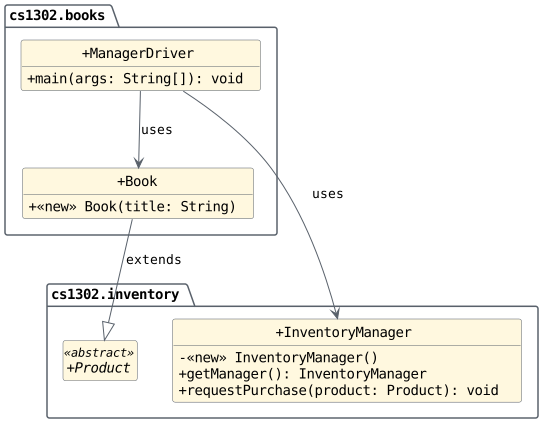
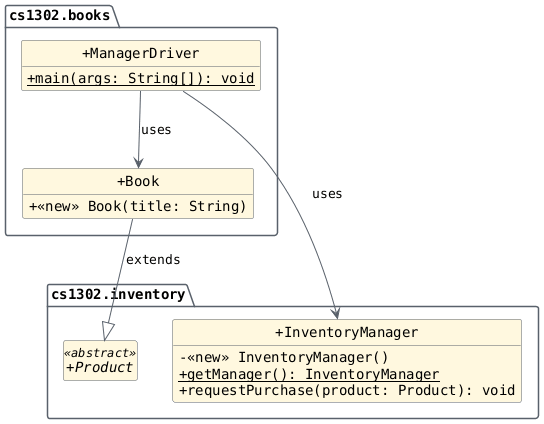
Inside InventoryManager, getManager executes
return new InventoryManager();. requestPurchase accepts a reference
to a product object and returns without a value; it rejects null.
Source file: cs1302/books/ManagerDriver.java
Obtain a new manager through its public static method, then supply a
reference to a new book in a call to requestPurchase. Keep the
constructor private and leave all declarations in their existing packages.
Text version of Visibility Problem 6
Place this main method in ManagerDriver. It imports
InventoryManager from cs1302.inventory.
Inside InventoryManager, getManager executes
return new InventoryManager();. requestPurchase accepts a reference
to a product object and returns without a value; it rejects null.
Source file: cs1302/books/ManagerDriver.java
Obtain a new manager through its public static method, then supply a
reference to a new book in a call to requestPurchase. Keep the
constructor private and leave all declarations in their existing packages.
Write the letters of the correct blocks in order and give each block an indentation level. Leave incorrect blocks unused and preserve relative indentation within each block.
Block A
InventoryManager manager = new InventoryManager();
Block B
/**
 * Demonstrate visibility using the supplied arguments.
 * @param args command-line arguments
 */
public static void main(String[] args) {
Block C
InventoryManager manager = InventoryManager.getManager();
Block D
} // main
Block E
manager.requestPurchase(new Book("LOTR"));
Sample solution for Visibility Problem 6
Block order: B, C, E, D.
Indentation levels: 0, 1, 1, 0.
/**
 * Demonstrate visibility using the supplied arguments.
 * @param args command-line arguments
 */
public static void main(String[] args) {
InventoryManager manager = InventoryManager.getManager();
manager.requestPurchase(new Book("LOTR"));
} // main
The private constructor is accessible inside InventoryManager, where
getManager creates the manager object. That public static method returns
with a reference value, which the caller stores in manager. It does
not return with a copy of the manager object. Direct construction from
ManagerDriver produces a compile-time error even though the class
itself is public. The reference value supplied to requestPurchase is
passed by value, not by reference.
Problem 7: Use Protected Access without Inheritance
Use the classes shown below.
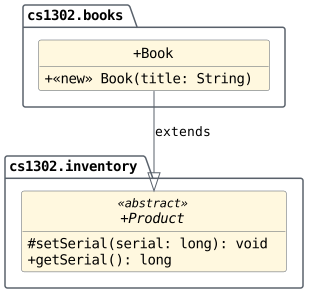
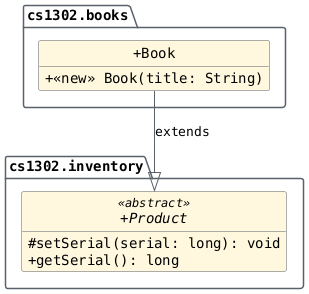
Both classes are imported in the supplied code, regardless of which caller package you choose.
Source file: cs1302/inventory/SerialDriver.java
Assemble SerialDriver.java to set the book's serial number to 21
and print it. Choose the caller's package so the protected method call
is permitted. SerialDriver must extend only Object; do not add
an extends Product declaration or change existing visibilities.
Text version of Visibility Problem 7
Use the classes shown below.
Both classes are imported in the supplied code, regardless of which caller package you choose.
Source file: cs1302/inventory/SerialDriver.java
Assemble SerialDriver.java to set the book's serial number to 21
and print it. Choose the caller's package so the protected method call
is permitted. SerialDriver must extend only Object; do not add
an extends Product declaration or change existing visibilities.
Write the letters of the correct blocks in order and give each block an indentation level. Leave incorrect blocks unused and preserve relative indentation within each block.
Block A
package cs1302.books;
Block B
package cs1302.inventory;
Block C
import cs1302.books.Book;
import cs1302.inventory.Product;

/** Demonstrates visibility from the chosen package. */
public class SerialDriver {
Block D
} // SerialDriver
Block E
/**
 * Demonstrate visibility using the supplied arguments.
 * @param args command-line arguments
 */
public static void main(String[] args) {
    Product product = new Book("LOTR");
    product.setSerial(21);
    System.out.println(product.getSerial());
} // main
Sample solution for Visibility Problem 7
Block order: B, C, E, D.
Indentation levels: 0, 0, 1, 0.
package cs1302.inventory;
import cs1302.books.Book;
import cs1302.inventory.Product;

/** Demonstrates visibility from the chosen package. */
public class SerialDriver {
/**
 * Demonstrate visibility using the supplied arguments.
 * @param args command-line arguments
 */
public static void main(String[] args) {
    Product product = new Book("LOTR");
    product.setSerial(21);
    System.out.println(product.getSerial());
} // main
} // SerialDriver
Within cs1302.inventory, the protected setSerial method is
accessible from SerialDriver even though that class is not a subclass
of Product. Moving this caller to cs1302.books produces a
compile-time error at product.setSerial(21). Sharing a package with
Book does not mean sharing the package that declares setSerial;
that declaration is in Product. The object's runtime class does not
change the caller's location.
Problem 8: Check the Qualifying Expression for Protected Access
Work inside Book in cs1302.books. Its superclass Product
is imported from cs1302.inventory.
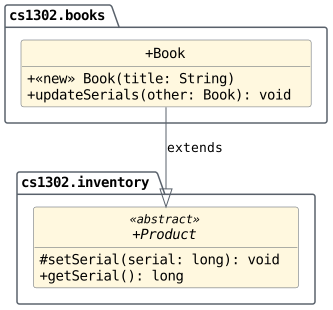
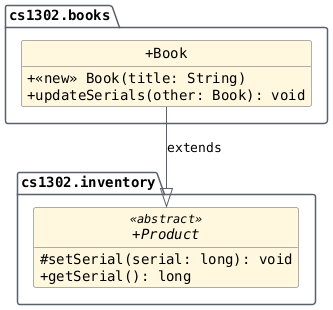
The supplied other argument refers to a different book object. Both
other and the local variable product will refer to that same object,
but their declared types differ.
Source file: cs1302/books/Book.java
Assemble updateSerials inside Book. Copy the reference value from
other into a Product variable named product, then set this book's
serial number to 10 and the other book's serial number to 20. Use a
qualifying expression permitted by the protected-access rule; do not
change either variable's declared type.
Text version of Visibility Problem 8
Work inside Book in cs1302.books. Its superclass Product
is imported from cs1302.inventory.
The supplied other argument refers to a different book object. Both
other and the local variable product will refer to that same object,
but their declared types differ.
Source file: cs1302/books/Book.java
Assemble updateSerials inside Book. Copy the reference value from
other into a Product variable named product, then set this book's
serial number to 10 and the other book's serial number to 20. Use a
qualifying expression permitted by the protected-access rule; do not
change either variable's declared type.
Write the letters of the correct blocks in order and give each block an indentation level. Leave incorrect blocks unused and preserve relative indentation within each block.
Block A
this.setSerial(10);
other.setSerial(20);
Block B
this.setSerial(10);
product.setSerial(20);
Block C
Product product = other; // Copy the reference value.
Block D
} // updateSerials
Block E
/**
 * Demonstrate permitted protected access from this subclass.
 * @param other non-null reference to a book object
 */
public void updateSerials(Book other) {
Text version of Visibility Problem 8
Work inside Book in cs1302.books. Its superclass Product
is imported from cs1302.inventory.
The supplied other argument refers to a different book object. Both
other and the local variable product will refer to that same object,
but their declared types differ.
Source file: cs1302/books/Book.java
Assemble updateSerials inside Book. Copy the reference value from
other into a Product variable named product, then set this book's
serial number to 10 and the other book's serial number to 20. Use a
qualifying expression permitted by the protected-access rule; do not
change either variable's declared type.
Write the letters of the correct blocks in order and give each block an indentation level. Leave incorrect blocks unused and preserve relative indentation within each block.
Block A
this.setSerial(10);
other.setSerial(20);
Block B
this.setSerial(10);
product.setSerial(20);
Block C
Product product = other; // Copy the reference value.
Block D
} // updateSerials
Block E
/**
* Demonstrate permitted protected access from this subclass.
* @param other non-null reference to a book object
*/
public void updateSerials(Book other) {
Sample solution for Visibility Problem 8
Block order: E, C, A, D.
Indentation levels: 0, 1, 1, 0.
/**
* Demonstrate permitted protected access from this subclass.
* @param other non-null reference to a book object
*/
public void updateSerials(Book other) {
Product product = other; // Copy the reference value.
this.setSerial(10);
other.setSerial(20);
} // updateSerials
The access occurs inside Book, a subclass in a different package
from the declaring class Product. For protected instance member access
through a qualifying expression here, that expression's compile-time type
must be Book or a subclass of Book. other meets this requirement;
product does not, even though both variables refer to the same object.
The alternative therefore produces a compile-time error. The two assignments
share a block because they affect different book objects and can occur in
either order; neither assignment changes a reference variable.
Runnable Sample Solutions
The simple/src directory contains the simplified Book from
Problems 1–3, including the copy constructor added in Problem 2.
The extended/src directory contains Book extends Product and
the callers from Problems 4–8. Compile these source directories
separately: they intentionally contain different versions of Book.
Bundle
Execute the command below to download and extract the files:
bundle1302 visibility-parsons
- downloading cs1302-visibility-parsons bundle...
- verifying integrity of downloaded files using sha256sum...
- extracting downloaded archive...
- removing intermediate files...
subdirectory cs1302-visibility-parsons successfully created