8.10. Additional Practice Exercises
8.10.1. Code Tracing
Code Tracing
To see sample solutions, click on the "Configure activity" button and select "Show solutions" from the menu that appears.
Sample solutions not included, because "Show solutions" was not selected before printing.
Note
The objective of the following exercises is for students to
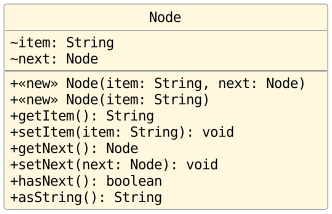
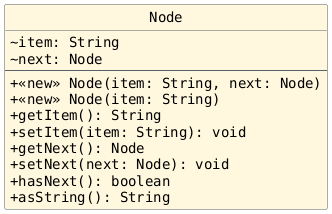
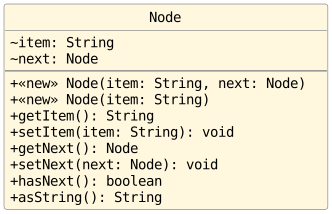
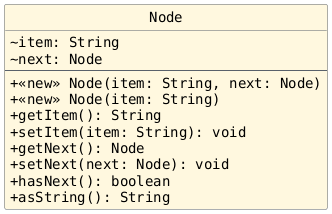
understand how nodes are created and linked in memory using the
Node class. They should be able to trace references step by
step to predict program output and recognize that next can be
reassigned.
Question 1
Draw the memory map for the following code:
Node n1 = new Node("A");
Node n2 = new Node("B");
n1.setNext(n2);
Sample Visualizations
Use the stepper controls to follow execution through the exercise
code in the generated Driver.java file. Calls to Node
constructors and methods execute without pausing inside Node.java.
Each caption identifies the line where execution is paused; that line
is the next to execute and has not yet executed.

Memory state while tracing the creation and linking of nodes through n1 and n2. Note: The debugger breakpoint is on line 4 in Driver.java. [download] [open]

Memory state while tracing the creation and linking of nodes through n1 and n2. Note: The debugger breakpoint is on line 5 in Driver.java. [download] [open]


Question 2
Draw the memory map for the following code and write the output given in the final line.
Node x = new Node("X");
x.setNext(new Node("Y"));
x.getNext().setNext(new Node("Z"));

System.out.println(x.getNext().getNext().getItem());
Sample Solution

Memory state while tracing the node chain accessed through x. Note: The debugger breakpoint is on line 4 in Driver.java. [download] [open]
> (no output yet)>_ Console Output 

Memory state while tracing the node chain accessed through x. Note: The debugger breakpoint is on line 5 in Driver.java. [download] [open]
> (no output yet)>_ Console Output 

Memory state while tracing the node chain accessed through x. Note: The debugger breakpoint is on line 6 in Driver.java. [download] [open]
> (no output yet)>_ Console Output 


Output Z
Question 3
Draw the memory map for the following code and write the output given in the final line.
1Node n1 = new Node("one");
2Node n2 = new Node("two");
3Node n3 = new Node("three");
4
5n1.setNext(n2);
6n2.setNext(n3);
7n1.setNext(n3);
8
9System.out.println(n1.getNext().getItem());
Sample Solution

Memory state while tracing changes to links among n1, n2, and n3. Note: The debugger breakpoint is on line 4 in Driver.java. [download] [open]
> (no output yet)>_ Console Output 

Memory state while tracing changes to links among n1, n2, and n3. Note: The debugger breakpoint is on line 5 in Driver.java. [download] [open]
> (no output yet)>_ Console Output 

Memory state while tracing changes to links among n1, n2, and n3. Note: The debugger breakpoint is on line 6 in Driver.java. [download] [open]
> (no output yet)>_ Console Output 

Memory state while tracing changes to links among n1, n2, and n3. Note: The debugger breakpoint is on line 8 in Driver.java. [download] [open]
> (no output yet)>_ Console Output 

Memory state while tracing changes to links among n1, n2, and n3. Note: The debugger breakpoint is on line 9 in Driver.java. [download] [open]
> (no output yet)>_ Console Output 

Memory state while tracing changes to links among n1, n2, and n3. Note: The debugger breakpoint is on line 10 in Driver.java. [download] [open]
> (no output yet)>_ Console Output 


Output
three
Question 4
Draw the memory map for the following code and write the output given in the final line.
 1 Node n1 = new Node("alpha");
 2 Node n2 = new Node("beta");
 3 Node n3 = new Node("gamma");
 4
 5 n1.setNext(n2);
 6 n2.setNext(n3);
 7
 8 Node p = n1.getNext();
 9 p.setNext(new Node("delta"));
10
11 System.out.println(n2.getNext().getItem());
Sample Solution

Memory state while tracing changes to node links through the shared reference in p. Note: The debugger breakpoint is on line 4 in Driver.java. [download] [open]
> (no output yet)>_ Console Output 

Memory state while tracing changes to node links through the shared reference in p. Note: The debugger breakpoint is on line 5 in Driver.java. [download] [open]
> (no output yet)>_ Console Output 

Memory state while tracing changes to node links through the shared reference in p. Note: The debugger breakpoint is on line 6 in Driver.java. [download] [open]
> (no output yet)>_ Console Output 

Memory state while tracing changes to node links through the shared reference in p. Note: The debugger breakpoint is on line 8 in Driver.java. [download] [open]
> (no output yet)>_ Console Output 

Memory state while tracing changes to node links through the shared reference in p. Note: The debugger breakpoint is on line 9 in Driver.java. [download] [open]
> (no output yet)>_ Console Output 

Memory state while tracing changes to node links through the shared reference in p. Note: The debugger breakpoint is on line 11 in Driver.java. [download] [open]
> (no output yet)>_ Console Output 

Memory state while tracing changes to node links through the shared reference in p. Note: The debugger breakpoint is on line 12 in Driver.java. [download] [open]
> (no output yet)>_ Console Output 


Output
delta
Question 5
Draw the memory map for the code below and write the output produced by the following code:
4Node n1 = new Node("A");
5n1.setNext(n1);
6System.out.println(n1.getNext().getNext().getNext().getItem());

Question 6
Draw the memory map for the code below and write the output produced by the following code:
4Node n1 = new Node("A");
5n1.setNext(new Node("B", n1));
6System.out.println(n1.getNext().getNext().getNext().getItem());
7System.out.println(n1.getNext().getNext().getNext().getNext().getItem());

Question 7
Draw the memory map for the following code and then write the output.
player1, player2, and player3.¶ 4Node player1 = new Node("Mario");
5player1.setItem("Luigi");
6
7new Node("Peach", player1);
8
9Node player2 = new Node("Yoshi");
10player2.setNext(player1);
11player1.setNext(new Node("Bowser"));
12player2.getNext().getNext().setNext(new Node("DonkeyKong"));
13
14Node player3 = player2.getNext().getNext();
15player3.getNext().setNext(new Node("Toad"));
16
17System.out.println(player3.getNext().getNext().getNext());
18System.out.println(player2.getItem());
19System.out.println(player1.getNext().getNext().getItem());
20System.out.println(player3.getNext().getNext().getItem());
21
22player1.setNext(new Node("Wario"));
23
24System.out.println(player1.getNext().getNext());
Solution
Output
null
Yoshi
DonkeyKong
Toad
null

Memory state while tracing node items and links through player1, player2, and player3. Note: The debugger breakpoint is on line 4 in Driver.java. [download] [open]
> (no output yet)>_ Console Output 

Memory state while tracing node items and links through player1, player2, and player3. Note: The debugger breakpoint is on line 5 in Driver.java. [download] [open]
> (no output yet)>_ Console Output 

Memory state while tracing node items and links through player1, player2, and player3. Note: The debugger breakpoint is on line 7 in Driver.java. [download] [open]
> (no output yet)>_ Console Output 

Memory state while tracing node items and links through player1, player2, and player3. Note: The debugger breakpoint is on line 9 in Driver.java. [download] [open]
> (no output yet)>_ Console Output 

Memory state while tracing node items and links through player1, player2, and player3. Note: The debugger breakpoint is on line 10 in Driver.java. [download] [open]
> (no output yet)>_ Console Output 

Memory state while tracing node items and links through player1, player2, and player3. Note: The debugger breakpoint is on line 11 in Driver.java. [download] [open]
> (no output yet)>_ Console Output 

Memory state while tracing node items and links through player1, player2, and player3. Note: The debugger breakpoint is on line 12 in Driver.java. [download] [open]
> (no output yet)>_ Console Output 

Memory state while tracing node items and links through player1, player2, and player3. Note: The debugger breakpoint is on line 14 in Driver.java. [download] [open]
> (no output yet)>_ Console Output 

Memory state while tracing node items and links through player1, player2, and player3. Note: The debugger breakpoint is on line 15 in Driver.java. [download] [open]
> (no output yet)>_ Console Output 

Memory state while tracing node items and links through player1, player2, and player3. Note: The debugger breakpoint is on line 17 in Driver.java. [download] [open]
> (no output yet)>_ Console Output 

Memory state while tracing node items and links through player1, player2, and player3. Note: The debugger breakpoint is on line 18 in Driver.java. [download] [open]
null
>_ Console Output 

Memory state while tracing node items and links through player1, player2, and player3. Note: The debugger breakpoint is on line 19 in Driver.java. [download] [open]
null
Yoshi
>_ Console Output 

Memory state while tracing node items and links through player1, player2, and player3. Note: The debugger breakpoint is on line 20 in Driver.java. [download] [open]
null
Yoshi
DonkeyKong
>_ Console Output 

Memory state while tracing node items and links through player1, player2, and player3. Note: The debugger breakpoint is on line 22 in Driver.java. [download] [open]
null
Yoshi
DonkeyKong
Toad
>_ Console Output 


8.10.2. Parsons Problems
Parsons Problems
To see sample solutions, click on the "Configure activity" button and select "Show solutions" from the menu that appears.
Sample solutions not included, because "Show solutions" was not selected before printing.
Arrange the blocks to construct each method using the
Node class. Read item and next reference
values with getItem() and getNext(); change them with
setItem(...) and setNext(...). Do not access fields directly.
Constructors initialize new nodes. Each method can be placed in a
driver class alongside the chapter's Node class.
Each problem includes one or two incorrect blocks. Use every correct block once and leave the incorrect blocks unused. Arrange blocks vertically and set each block's indentation. Level zero contains the method declaration and its closing brace, level one contains method statements, and level two contains statements inside a loop. Each level represents four spaces. Keep the relative indentation of lines within a block unchanged. Use the interactive controls or open the text version to solve the same problem on paper or without JavaScript. Letters in the text version identify whole blocks, not individual lines. Open the sample solution after attempting a problem.
Problem 1: Build a three-node chain
Construct makeChain so that it returns with a reference to the first of
three new nodes containing "A", "B", and "C", in that order.
Create each node with the one-argument constructor and connect the nodes
using setNext. The final node's next reference value must be null.
Text version of Problem 1
Construct makeChain so that it returns with a reference to the first of
three new nodes containing "A", "B", and "C", in that order.
Create each node with the one-argument constructor and connect the nodes
using setNext. The final node's next reference value must be null.
Write the letters of the correct blocks in order and give each block an indentation level. Leave incorrect blocks unused and preserve relative indentation within each block.
Block A
Node head = new Node("A");
Block B
public static Node makeChain() {
Block C
head.getNext().setNext(new Node("C"));
Block D
return head;
Block E
head.setNext(new Node("C"));
Block F
head.setNext(new Node("B"));
Block G
}
Sample solution for Problem 1
Block order: B, A, F, C, D, G.
Indentation levels: 0, 1, 1, 1, 1, 0.
public static Node makeChain() {
    Node head = new Node("A");
    head.setNext(new Node("B"));
    head.getNext().setNext(new Node("C"));
    return head;
}
getNext retrieves the reference value for the second node, so
calling setNext on that node adds the third node after it. Calling
head.setNext again replaces the first node's successor: the chain
reachable from head would contain only A and C. The one-argument
constructor initializes each new node's next reference value to null.
Problem 2: Modify an item through an alias
Construct markSecond. Assume head refers to a node with a
successor, and the successor's item is a non-null String. Append
"!" to that item's value through a local reference named alias,
then return with the updated reference value obtained through head. Preserve every
node and link; do not allocate a replacement node.
Text version of Problem 2
Construct markSecond. Assume head refers to a node with a
successor, and the successor's item is a non-null String. Append
"!" to that item's value through a local reference named alias,
then return with the updated reference value obtained through head. Preserve every
node and link; do not allocate a replacement node.
Write the letters of the correct blocks in order and give each block an indentation level. Leave incorrect blocks unused and preserve relative indentation within each block.
Block A
Node alias = new Node(head.getNext().getItem());
Block B
return head.getNext().getItem();
Block C
Node alias = head.getNext();
Block D
public static String markSecond(Node head) {
Block E
String original = alias.getItem();
Block F
alias.setItem(original + "!");
Block G
}
Sample solution for Problem 2
Block order: D, C, E, F, B, G.
Indentation levels: 0, 1, 1, 1, 1, 0.
public static String markSecond(Node head) {
    Node alias = head.getNext();
    String original = alias.getItem();
    alias.setItem(original + "!");
    return head.getNext().getItem();
}
Assigning the result of head.getNext() copies a reference value.
Both alias and the first node's next field then refer to the same
node. getItem reads its item, and setItem replaces that item's
reference value. It does not modify the original String object.
The distractor creates a separate node, so the original successor's
item would remain unchanged.
Problem 3: Prepend a node
Construct prepend to allocate one new node containing item
and return with a reference to it as the new head. Its successor must be
the original head. The input head may be null. Preserve all
existing nodes, items, and links.
Text version of Problem 3
Construct prepend to allocate one new node containing item
and return with a reference to it as the new head. Its successor must be
the original head. The input head may be null. Preserve all
existing nodes, items, and links.
Write the letters of the correct blocks in order and give each block an indentation level. Leave incorrect blocks unused and preserve relative indentation within each block.
Block A
public static Node prepend(Node head, String item) {
Block B
added.setNext(head);
Block C
head.setNext(added);
Block D
return added;
Block E
Node added = new Node(item);
Block F
}
Sample solution for Problem 3
Block order: A, E, B, D, F.
Indentation levels: 0, 1, 1, 1, 0.
public static Node prepend(Node head, String item) {
    Node added = new Node(item);
    added.setNext(head);
    return added;
}
The new node stores a copy of the original head's reference value
through setNext. This works even when that value is null.
Returning with the reference value stored in added lets the caller store the new head; assigning a
method parameter would not update the caller's variable. The distractor
changes an existing link and throws NullPointerException for an
empty chain.
Problem 4: Insert after a given node
Construct insertAfter to insert one new node containing item
immediately after previous. Assume previous is non-null; its
next reference value may be null. Preserve every existing node and
item, and keep the original successor after the inserted node.
Text version of Problem 4
Construct insertAfter to insert one new node containing item
immediately after previous. Assume previous is non-null; its
next reference value may be null. Preserve every existing node and
item, and keep the original successor after the inserted node.
Write the letters of the correct blocks in order and give each block an indentation level. Leave incorrect blocks unused and preserve relative indentation within each block.
Block A
added.setNext(previous.getNext());
Block B
Node added = new Node(item);
Block C
added.setNext(previous);
Block D
public static void insertAfter(Node previous, String item) {
Block E
previous.setNext(added);
Block F
}
Sample solution for Problem 4
Block order: D, B, A, E, F.
Indentation levels: 0, 1, 1, 1, 0.
public static void insertAfter(Node previous, String item) {
    Node added = new Node(item);
    added.setNext(previous.getNext());
    previous.setNext(added);
}
Read the original successor with getNext and store its reference
value in the new node before replacing the link from previous.
Reversing those two updates makes the new node its own successor.
The distractor instead links back to previous, forming a two-node
cycle after attachment and losing the original suffix from that chain.
Problem 5: Remove a successor
Construct removeAfter to remove the node immediately after
previous from a chain and return with a reference to the removed node.
Assume previous and its successor are non-null. The removed node
may be the final node. Preserve all item values and all links except
previous's next link; leave the removed node's own link unchanged.
Text version of Problem 5
Construct removeAfter to remove the node immediately after
previous from a chain and return with a reference to the removed node.
Assume previous and its successor are non-null. The removed node
may be the final node. Preserve all item values and all links except
previous's next link; leave the removed node's own link unchanged.
Write the letters of the correct blocks in order and give each block an indentation level. Leave incorrect blocks unused and preserve relative indentation within each block.
Block A
public static Node removeAfter(Node previous) {
Block B
Node successor = removed.getNext();
Block C
previous.setNext(null);
Block D
previous.setNext(successor);
Block E
Node removed = previous.getNext();
Block F
return removed;
Block G
}
Sample solution for Problem 5
Block order: A, E, B, D, F, G.
Indentation levels: 0, 1, 1, 1, 1, 0.
public static Node removeAfter(Node previous) {
    Node removed = previous.getNext();
    Node successor = removed.getNext();
    previous.setNext(successor);
    return removed;
}
removed preserves a reference to the node being bypassed.
successor stores that node's next reference value, which may be
null. Setting the predecessor's link to this value preserves the
remaining suffix. The distractor works only when removing the final
node; otherwise it disconnects the suffix from previous. Removing
a node from a chain does not destroy the object.
Problem 6: Print every item
Construct printItems to print each item's value on its own line,
from the first node through the final node. Print nothing for an empty
chain. Assume a finite, acyclic chain; head may be null. Preserve
the value of head and every node's item and link.
Text version of Problem 6
Construct printItems to print each item's value on its own line,
from the first node through the final node. Print nothing for an empty
chain. Assume a finite, acyclic chain; head may be null. Preserve
the value of head and every node's item and link.
Write the letters of the correct blocks in order and give each block an indentation level. Leave incorrect blocks unused and preserve relative indentation within each block.
Block A
current.setNext(current.getNext());
Block B
}
Block C
while (current != null) {
Block D
while (current.hasNext()) {
Block E
Node current = head;
Block F
current = current.getNext();
Block G
System.out.println(current.getItem());
Block H
public static void printItems(Node head) {
Block I
}
Sample solution for Problem 6
Block order: H, E, C, G, F, B, I.
Indentation levels: 0, 1, 1, 2, 2, 1, 0.
public static void printItems(Node head) {
    Node current = head;
    while (current != null) {
        System.out.println(current.getItem());
        current = current.getNext();
    }
}
The loop processes the node currently referenced by current
before advancing. Testing current != null includes the final node
and safely handles an empty chain. hasNext tests for a successor,
so it is the wrong condition when every node must be processed.
Assigning current.getNext() to the local variable advances traversal
without changing any links. The setter distractor leaves current
unchanged, so the loop repeats indefinitely for a nonempty chain.
Problem 7: Count the nodes
Construct countNodes to return with the number of nodes reachable
from head. Return with zero for an empty chain. Assume a finite, acyclic
chain with at most Integer.MAX_VALUE nodes. Preserve the value of
head and every node's item and link.
Text version of Problem 7
Construct countNodes to return with the number of nodes reachable
from head. Return with zero for an empty chain. Assume a finite, acyclic
chain with at most Integer.MAX_VALUE nodes. Preserve the value of
head and every node's item and link.
Write the letters of the correct blocks in order and give each block an indentation level. Leave incorrect blocks unused and preserve relative indentation within each block.
Block A
int count = 0;
Node current = head;
Block B
return count;
Block C
}
Block D
while (current != null) {
Block E
int count = 1;
Node current = head;
Block F
count++;
current = current.getNext();
Block G
public static int countNodes(Node head) {
Block H
}
Sample solution for Problem 7
Block order: G, A, D, F, C, B, H.
Indentation levels: 0, 1, 1, 2, 1, 1, 0.
public static int countNodes(Node head) {
int count = 0;
Node current = head;
while (current != null) {
count++;
current = current.getNext();
}
return count;
}
Initially no nodes have been visited, so count starts at zero.
Each iteration counts one node and advances to its successor. When
current becomes null, every reachable node has been counted.
The paired distractor incorrectly counts a node before visiting one.
The two initializations share a block because either could be written
first without changing the result.
Problem 8: Append a node
Construct append to allocate one new node containing item
and append it to a finite, acyclic chain. Return with the original head reference for
a nonempty chain, or the new node for an empty chain. Preserve existing
items and links except for the original final node's next link.
The empty-chain case is grouped into one block. Preserve its internal indentation while setting the indentation of the whole block.
Text version of Problem 8
Construct append to allocate one new node containing item
and append it to a finite, acyclic chain. Return with the original head reference for
a nonempty chain, or the new node for an empty chain. Preserve existing
items and links except for the original final node's next link.
The empty-chain case is grouped into one block. Preserve its internal indentation while setting the indentation of the whole block.
Write the letters of the correct blocks in order and give each block an indentation level. Leave incorrect blocks unused and preserve relative indentation within each block.
Block A
}
current.setNext(added);
Block B
return added;
Block C
public static Node append(Node head, String item) {
Block D
Node current = head;
while (current.getNext() != null) {
Block E
Node current = head;
while (current != null) {
Block F
return head;
Block G
Node added = new Node(item);
if (head == null) {
    return added;
}
Block H
current = current.getNext();
Block I
}
Text version of Problem 8
Construct append to allocate one new node containing item
and append it to a finite, acyclic chain. Return with the original head reference for
a nonempty chain, or the new node for an empty chain. Preserve existing
items and links except for the original final node's next link.
The empty-chain case is grouped into one block. Preserve its internal indentation while setting the indentation of the whole block.
Write the letters of the correct blocks in order and give each block an indentation level. Leave incorrect blocks unused and preserve relative indentation within each block.
Block A
}
current.setNext(added);
Block B
return added;
Block C
public static Node append(Node head, String item) {
Block D
Node current = head;
while (current.getNext() != null) {
Block E
Node current = head;
while (current != null) {
Block F
return head;
Block G
Node added = new Node(item);
if (head == null) {
return added;
}
Block H
current = current.getNext();
Block I
}
Sample solution for Problem 8
Block order: C, G, D, H, A, F, I.
Indentation levels: 0, 1, 1, 2, 1, 1, 0.
public static Node append(Node head, String item) {
Node added = new Node(item);
if (head == null) {
return added;
}
Node current = head;
while (current.getNext() != null) {
current = current.getNext();
}
current.setNext(added);
return head;
}
Handle an empty chain before dereferencing a node. For a nonempty
chain, stop at the node whose next reference value is null and
attach the new node there. Testing current != null instead advances
past that node and causes NullPointerException at setNext.
Return with the original head reference so that the caller can still reach the entire
chain; returning with the reference value stored in added would expose only the new final node.