3. Urgency Queue v2026.fa
Notice
This document contains the description for the Urgency Queue project intended for students in the Fall 2026 CSCI 1302 classes at the University of Georgia.
3.1. Project Deadlines
This Urgency Queue project is broken up into three parts, and each part has its own deadline. The deadlines for each part are summarized in the deadline table, and instructions are provided in the Project Checklist section later in this document.
Urgency Queue Deadlines
Part |
Due Date |
|---|---|
1 |
Monday, November 2nd @ 11:55 PM |
2 |
Sunday, November 8th @ 11:55 PM |
3 |
Thursday, November 12th @ 11:55 PM |
To earn full points, you are required to submit all three parts. If you want extra credit, then complete and submit the first and / or second parts before their deadlines, as explained in the drop-down below.
Submission-Based (SB) Extra Credit
Students who perform their final submission for Part 1 and / or Part 2 of the project via the specific submit1302 command mentioned for that part before its deadline stated in the deadline table will automatically receive +5 points of Submission-Based (SB) extra credit for that part. This assumes the submission also earns other credit since extra credit is extra and never intended to be the only credit earned.
If a student submits each part of the project correctly and on time, then the highest grade they can earn overall is 110 instead of 100.
Late Penalties
Late penalties do not start applying until after the final date/time listed in the deadline table.
3.2. Project Preface
This third CSCI 1302 project for Fall 2026 is designed to help you apply and extend your prerequisite Java programming knowledge with new concepts from CSCI 1302 in a Unix development environment (i.e., Odin).
Motivation
This project will require you to apply several advanced concepts covered in CSCI 1302, including generic types and type bounds, functional interfaces, lambda expressions, exceptions, named packages, and Java development in a Unix environment. It will also require you to design and implement an object-oriented hierarchy utilizing interfaces, abstract classes, inheritance, and polymorphism to maximize code reuse. If you have actively engaged with the CSCI 1302 course content offered so far this semester, then you should be able to comfortably, but not necessarily quickly, complete those aspects of the project by applying what you have practiced and learned from your content engagement.
Finally, this project may require you to do things that you have never been given explicit directions or instructions for — this is just a part of software development. In such cases, you may need to do some research to help you plan your solution. That being said, we have carefully prepared this project description document so that it answers the majority of your questions. If not, then please do not hesitate to ask a question on the course Piazza or during office hours.
Academic Honesty
All students at the University of Georgia explicitly agree to abide by the UGA student honor code when they sign the application for their admission to the University. Additionally, all students enrolled in a CSCI 1302 course section in Fall 2026 are subject to the Academic Honesty policy included in the Fall 2026 CSCI 1302 course syllabus. Furthermore, anyone with access to this project description document is expected to respect the copyright and licensing terms provided or linked to at the bottom of this document and the starter code.
With academic honesty in mind, we ask all Fall 2026 CSCI 1302 students not to fork the project repository on GitHub. Doing so may make your copy of the project publicly visible, and that can violate several of the policies described earlier. Instead of forking the repository, please follow the instructions provided later in this document to acquire a copy of the starter code.
Course-Specific Learning Outcomes
If you work on and complete this project, then you will gain exposure and practice with the following learning outcomes:
# |
Exposure |
Description |
|---|---|---|
LO1.c |
⭐⭐ |
Create and modify text files and source code using a powerful terminal-based text editor such as Emacs or Vi. |
LO1.d |
⭐⭐ |
Use shell commands to compile new and existing software solutions that are organized into multi-level packages. |
LO2.a |
⭐⭐ |
Identify redundancy in a set of classes and interfaces, then refactor using inheritance and polymorphism. |
LO2.b |
⭐⭐ |
Define, throw, and propagate exceptions appropriately in a software solution. |
LO2.d |
⭐⭐ |
Implement, design, and use generic classes, interfaces, and methods with type bounds. |
LO2.e |
⭐⭐ |
Utilize functional interfaces and lambda expressions to pass behavior as arguments. |
LO3.a |
⭐⭐ |
Create and update source code that adheres to established style guidelines. |
LO3.b |
⭐⭐ |
Create class, interface, method, and inline documentation that satisfies a set of requirements. |
LO4.c |
⭐⭐ |
Design, create and use inheritance relationships in a software solution. |
LO7.c |
⭐⭐ |
Use common abstract data types and structures, including queues and linked lists, in solving typical problems. |
Project Updates
If your instructor updates the project requirements or starter code before the project is due, then this section will be updated to include a summary of those updates and, if needed, instructions that describe how to update your working copy of the project with the latest versions of any changed files.
3.3. Project Description
In this project, you are tasked with writing and testing the code for
two classes that each implement, in their own unique way, the
Abstract Data Type (ADT) described by the generic
UrgencyQueue<ItemType> interface that is declared in cs1302-urgency-queue.jar and documented in
its API documentation.
Required Reading
Make sure that you have completed the readings listed below prior to starting this project:
Introduction to Urgency Queue Objects
Package Conventions for Provided Code
Several of the UML diagrams in this project description include
packages with a <<jar>> or <<java>> stereotype. You do
not and must not recreate the classes and interfaces in these
packages since they are already provided for you.
The UrgencyQueue<ItemType> Interface
The UrgencyQueue<ItemType> interface defines an ADT for urgency-based
queue operations. From an external perspective, each urgency
queue object maintains a line of zero or more items (i.e.,
non-null references to objects of type
ItemType). Unlike a standard queue, which orders its line of
items according to FIFO (first-in-first-out) semantics, an
urgency queue associates a level of urgency with each item and
orders its items according to their relative level of urgency.
You will NOT be writing the code for this interface yourself;
instead, a compiled version is provided for you in
cs1302-urgency-queue.jar. Read the starter API documentation and the UML diagram
shown below in Fig. 3.1.
Fig. 3.1 UML diagram of the UrgencyQueue<ItemType> interface. [svg] [png]
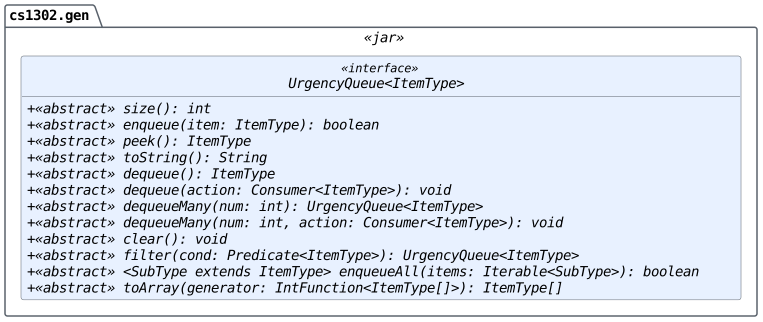
The enqueueAll method declares its own type parameter,
SubType, in addition to the ItemType parameter declared by the
interface. Its declaration, <SubType extends ItemType>, uses
ItemType as the upper bound for SubType. Refer to the
method details for enqueueAll
and Examples 2–3
in the provided API documentation.
The Implementing Classes
Both implementations use the same storage representation: a singly
linked chain of the provided Node<ItemType> objects. Their ordering policies
differ:
LinkedUrgencyQueueuses the natural ordering defined byComparable<ItemType>and itscompareTomethod.CustomLinkedUrgencyQueueuses theComparator<ItemType>supplied to its constructor. This lets a caller choose an urgency ordering independently of an item's natural ordering.
The abstract BaseLinkedUrgencyQueue class declares the shared size and head
instance variables and implements operations that both concrete
classes need. Each concrete queue object contains these inherited
fields once. Constructing a subclass object does not create a separate
base queue object.
Fig. 3.2 Both concrete classes extend the same abstract base and use the same provided node type. [svg] [png]
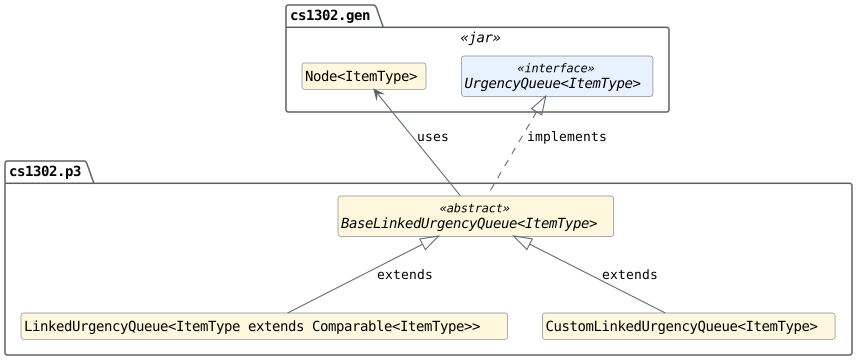
The class specifications distinguish declared members, inherited members, and each class's responsibilities.
The Provided Node Class
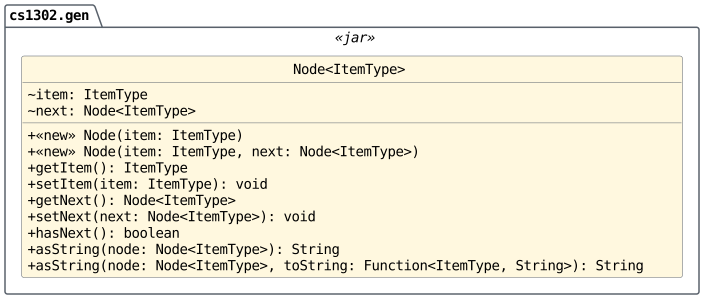
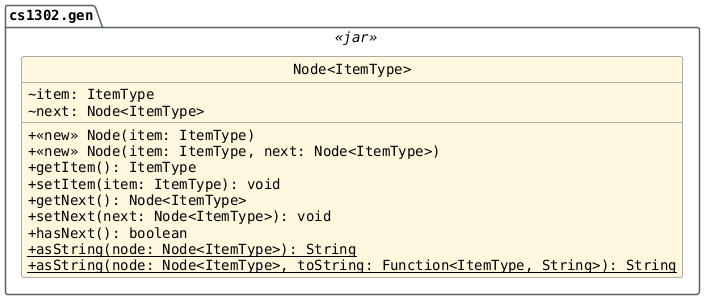
The Node<ItemType> class is provided in cs1302.gen. Its item and next
fields have package-private access. Your queue classes are in
cs1302.p3, so use the public getter methods and setter methods
(getItem, setItem, getNext, and
setNext) to read or replace those field values.
Fig. 3.3 The provided generic node class. The UML ~ visibility
symbol denotes package-private access. [svg] [png]
A node stores an item reference value and a next-node reference value.
If its next field has the value null, it does not refer to
another node. Distinguish replacing one of those reference values from
modifying the object to which that value refers.
The node example illustrates these relationships without implementing a queue insertion algorithm.
See the Node class API documentation
for code examples that illustrate how to create and use a linked list
of Node objects and visualize its links using
Node.asString.
Functional Interfaces
A functional interface has a single abstract method contract that a
lambda expression can implement. Default and static methods do not
count toward that contract, nor do abstract declarations matching
public methods of Object. The following links open the
official Java 25 API documentation.
These interfaces let you supply behavior to queue operations and provided helper methods:
Comparator<T> —
int compare(T a, T b)compares two items and returns with a negative integer, zero, or a positive integer to indicate their relative order. Custom urgency queues use this comparison to determine which item is more urgent.Consumer<T> —
void accept(T item)performs an action using an item and returns without a value when it completes normally. Thedequeue(action)anddequeueMany(num, action)methods use a consumer to process removed items.Predicate<T> —
boolean test(T item)checks an item and returns withtrueorfalse. The queue'sfiltermethod uses this result to select items for the new queue.IntFunction<R> —
R apply(int value)accepts anintand returns with a result of typeR. ThetoArraymethod accepts anIntFunction<ItemType[]>that supplies a reference to an array of the requested length.Function<T, R> —
R apply(T item)maps an input to a result. The providedNode.asString(node, toString)helper accepts aFunction<ItemType, String>to produce each item's text.
The following interfaces also satisfy the functional-interface definition. In this project, you encounter them mainly through classes that implement them, rather than through callback lambdas:
Comparable<T> —
int compareTo(T other)compares the receiving object with another object to define natural ordering. Natural-order urgency queues require items whose class implements the appropriateComparableinterface, such asPersonimplementingComparable<Person>.Iterable<T> —
Iterator<T> iterator()returns with a reference to an iterator over the elements. TheenqueueAllmethod accepts anIterableso it can visit the supplied items, including items supplied through aList.
Using and Testing Urgency Queue Objects
Understanding ADT Expectations
The interface API documentation specifies the behavior of each method, including exceptional completion and requirements about changes to the calling queue. Read its introduction and method specifications before planning an implementation.
Comparison Results and Stable Ties
For this assignment, the sign of a.compareTo(b) or
comparator.compare(a, b) determines urgency:
Result |
Required urgency relationship |
|---|---|
Negative |
|
Zero |
|
Positive |
|
Use the sign rather than assuming that a comparison produces only
-1, 0, or 1. The most urgent items appear first. For equal
urgency, preserve FIFO order: an item enqueued earlier remains before
an item enqueued later. Equal urgency does not require equal objects
or identical reference values.
For example, enqueue "aa", "b", "cc", and "dddd" in
that order into a custom queue whose comparator compares string
lengths. The queue's string representation must be
[dddd, aa, cc, b]. The two length-two strings retain their arrival
order. With the reversed length comparator, the representation must
be [b, aa, cc, dddd]: reversing the urgency relationship preserves
FIFO order within the tie.
The comparator teaching example lets you inspect comparison signs separately from queue implementation.
Observe Both the Result and the Calling Queue
Start with the length-ordered queue [dddd, aa, cc, b] above and
perform the following operations in sequence. Each method call that
completes normally with a queue result returns with a reference to a
new queue of the same concrete type as the calling queue. A custom
result queue uses the same comparator.
Define the following predicate using java.util.function.Predicate:
Predicate<String> isLength2 = (String item) -> {
    return item.length() == 2;
}; // lambda
Filtering selects items; bulk dequeue removes items.
Operation |
Result queue |
Calling queue afterward |
|---|---|---|
|
|
|
|
|
|
filter must leave the calling queue unchanged.
dequeueMany(int) removes the requested number of most urgent
items from that queue. Test the result, its ordering policy, and the
calling queue's state; checking only the result misses part of each
contract. For the consumer overloads, check the removed items' order
and the actions performed on them. User-supplied behavior must be
non-interfering, as described in the API documentation.
Boundary and Exception Contracts
An empty queue's peek() and dequeue() method calls must
complete abruptly with IllegalStateException.
Both dequeueMany overloads require
IllegalArgumentException for a negative count and
IllegalStateException when the count exceeds size().
A count of zero is valid when the other arguments satisfy their
contracts.
Read each null-argument rule separately. For example,
enqueue(null) requires NullPointerException, whereas
enqueueAll(items) requires IllegalArgumentException
if any item in a non-null iterable is null; that call must
leave the queue unchanged. A null iterable, predicate, action, or
array generator requires NullPointerException. These examples
supplement the API documentation, which specifies every method.
Oracle Classes for Testing
To assist you in testing your code, the starter JAR file provides
two fully implemented oracle classes in the cs1302.oracle
package:
These oracle classes satisfy all functional requirements of the assignment. You can construct oracle objects in your test programs to establish the expected behavior and compare results against your own implementations.
Provided JAR Classes: State, References, and Type Constraints
These programs use the provided Node<ItemType> class, oracle queue classes,
and data models from cs1302-urgency-queue.jar. The supplied
Person
and
Movie
classes let you explore ordering and type constraints without defining
replacement model classes. The programs demonstrate public API use;
they do not implement queue operations or belong in your project
submission.
Each execution pause occurs immediately before the highlighted driver line executes. Only the driver or short test program is displayed; the provided JAR supplies the library classes for compilation and execution. Follow the driver statements alongside the corresponding object state. The explanations below also describe the key states without requiring the interactive controls.
Construction and Initial State
Purpose: connect the class hierarchy to an object's initial state and distinguish copying a comparator reference value from constructing another comparator object.
Before line 21, natural refers to an empty natural-order oracle.
Before line 25, custom refers to an empty custom-order oracle;
its comparator field and byAge refer to the same comparator
object. Before line 26, both custom queues use that same comparator.
Each queue has its own inherited size and head fields, with
values 0 and null. The final pause is before line 27,
after the output statement has executed.
ConstructorDriver is an instructor-written demonstration class.
It is not included in the project starter code, and you do not need
to create it.
 1package cs1302.urgency.demo;
 2
 3import cs1302.gen.UrgencyQueue;
 4import cs1302.oracle.OracleCustomLinkedUrgencyQueue;
 5import cs1302.oracle.OracleLinkedUrgencyQueue;
 6import cs1302.oracle.model.Person;
 7import java.util.Comparator;
 8
 9/**
10 * Constructs the supplied oracle queues without implementing queue operations.
11 */
12public class ConstructorDriver {
13
14    /**
15     * Demonstrates empty state and a shared comparator reference value.
16     *
17     * @param args the command-line arguments, which are unused
18     */
19    public static void main(String[] args) {
20        UrgencyQueue<Person> natural = new OracleLinkedUrgencyQueue<Person>();
21        Comparator<Person> byAge = (Person personA, Person personB) -> {
22            return personA.age() - personB.age();
23        };
24        UrgencyQueue<Person> custom = new OracleCustomLinkedUrgencyQueue<Person>(byAge);
25        UrgencyQueue<Person> samePolicy = new OracleCustomLinkedUrgencyQueue<Person>(byAge);
26        System.out.println("Constructed one natural oracle and two custom oracles.");
27    } // main
28
29} // ConstructorDriver
19    public static void main(String[] args) {
20        UrgencyQueue<Person> natural = new OracleLinkedUrgencyQueue<Person>();
21        Comparator<Person> byAge = (Person personA, Person personB) -> {
22            return personA.age() - personB.age();
23        };
24        UrgencyQueue<Person> custom = new OracleCustomLinkedUrgencyQueue<Person>(byAge);
25        UrgencyQueue<Person> samePolicy = new OracleCustomLinkedUrgencyQueue<Person>(byAge);
26        System.out.println("Constructed one natural oracle and two custom oracles.");
27    } // main

Initial queue fields and shared comparator reference values. Note: The debugger breakpoint is on line 21 in ConstructorDriver.java. [code listing] [download] [open]
> (no output yet)>_ Console Output 
19    public static void main(String[] args) {
20        UrgencyQueue<Person> natural = new OracleLinkedUrgencyQueue<Person>();
21        Comparator<Person> byAge = (Person personA, Person personB) -> {
22            return personA.age() - personB.age();
23        };
24        UrgencyQueue<Person> custom = new OracleCustomLinkedUrgencyQueue<Person>(byAge);
25        UrgencyQueue<Person> samePolicy = new OracleCustomLinkedUrgencyQueue<Person>(byAge);
26        System.out.println("Constructed one natural oracle and two custom oracles.");
27    } // main

Initial queue fields and shared comparator reference values. Note: The debugger breakpoint is on line 25 in ConstructorDriver.java. [code listing] [download] [open]
> (no output yet)>_ Console Output 
19    public static void main(String[] args) {
20        UrgencyQueue<Person> natural = new OracleLinkedUrgencyQueue<Person>();
21        Comparator<Person> byAge = (Person personA, Person personB) -> {
22            return personA.age() - personB.age();
23        };
24        UrgencyQueue<Person> custom = new OracleCustomLinkedUrgencyQueue<Person>(byAge);
25        UrgencyQueue<Person> samePolicy = new OracleCustomLinkedUrgencyQueue<Person>(byAge);
26        System.out.println("Constructed one natural oracle and two custom oracles.");
27    } // main

Initial queue fields and shared comparator reference values. Note: The debugger breakpoint is on line 26 in ConstructorDriver.java. [code listing] [download] [open]
> (no output yet)>_ Console Output 
19    public static void main(String[] args) {
20        UrgencyQueue<Person> natural = new OracleLinkedUrgencyQueue<Person>();
21        Comparator<Person> byAge = (Person personA, Person personB) -> {
22            return personA.age() - personB.age();
23        };
24        UrgencyQueue<Person> custom = new OracleCustomLinkedUrgencyQueue<Person>(byAge);
25        UrgencyQueue<Person> samePolicy = new OracleCustomLinkedUrgencyQueue<Person>(byAge);
26        System.out.println("Constructed one natural oracle and two custom oracles.");
27    } // main

Initial queue fields and shared comparator reference values. Note: The debugger breakpoint is on line 27 in ConstructorDriver.java. [code listing] [download] [open]
Constructed one natural oracle and two custom oracles.
>_ Console Output 
The lambda body compares the two age values directly. The diagram
shows that body from the driver. The shared object identifier
confirms that byAge and both comparator fields refer to the
same lambda object within this trace.
The diagrams show actual oracle objects, including their inherited fields. A parent class constructor invocation operates on the same object being constructed; it does not construct a separate base queue object. Java supplies default values for instance fields before constructor execution. Local variables follow different definite assignment rules and are not automatically initialized to those defaults.
Node Reference Values and Aliases
Purpose: follow a short, manually constructed node chain and observe the difference between changing a node's item field and reassigning a local reference variable.
Before line 25, alias and middle refer to the same node;
itemAlias stores the item reference value read from that node.
Before line 27, the setter method has changed the node's item field,
while itemAlias still refers to the earlier item object. Before
line 30, reassigning alias makes that local variable refer to the
tail node; it has not changed the head node's next-node field. Before
line 33, all printed comparisons are available. The tail node's
next value remains null.
NodeDriver is an instructor-written demonstration class.
It is not included in the project starter code, and you do not need
to create it.
 1package cs1302.urgency.demo;
 2
 3import cs1302.gen.Node;
 4import cs1302.oracle.model.Person;
 5
 6/**
 7 * Demonstrates a manually constructed chain and node aliases, not a queue algorithm.
 8 */
 9public class NodeDriver {
10
11    /**
12     * Uses the supplied node's public getter and setter methods from another package.
13     *
14     * @param args the command-line arguments, which are unused
15     */
16    public static void main(String[] args) {
17        Person first = new Person(70, "C");
18        Person second = new Person(30, "A");
19        Person third = new Person(30, "B");
20        Node<Person> tail = new Node<Person>(third);
21        Node<Person> middle = new Node<Person>(second, tail);
22        Node<Person> head = new Node<Person>(first, middle);
23        Node<Person> alias = head.getNext();
24        Person itemAlias = alias.getItem();
25        System.out.println("Same node: " + (alias == middle));
26        alias.setItem(first);
27        System.out.println("Middle item: " + middle.getItem());
28        System.out.println("Earlier item reference: " + itemAlias);
29        alias = alias.getNext();
30        System.out.println("Local alias is tail: " + (alias == tail));
31        System.out.println("Head still links to middle: " + (head.getNext() == middle));
32        System.out.println("Tail has next node: " + tail.hasNext());
33    } // main
34
35} // NodeDriver
16    public static void main(String[] args) {
17        Person first = new Person(70, "C");
18        Person second = new Person(30, "A");
19        Person third = new Person(30, "B");
20        Node<Person> tail = new Node<Person>(third);
21        Node<Person> middle = new Node<Person>(second, tail);
22        Node<Person> head = new Node<Person>(first, middle);
23        Node<Person> alias = head.getNext();
24        Person itemAlias = alias.getItem();
25        System.out.println("Same node: " + (alias == middle));
26        alias.setItem(first);
27        System.out.println("Middle item: " + middle.getItem());
28        System.out.println("Earlier item reference: " + itemAlias);
29        alias = alias.getNext();
30        System.out.println("Local alias is tail: " + (alias == tail));
31        System.out.println("Head still links to middle: " + (head.getNext() == middle));
32        System.out.println("Tail has next node: " + tail.hasNext());
33    } // main

Node aliases, item aliases, and an unchanged chain link. Note: The debugger breakpoint is on line 25 in NodeDriver.java. [code listing] [download] [open]
> (no output yet)>_ Console Output 
16    public static void main(String[] args) {
17        Person first = new Person(70, "C");
18        Person second = new Person(30, "A");
19        Person third = new Person(30, "B");
20        Node<Person> tail = new Node<Person>(third);
21        Node<Person> middle = new Node<Person>(second, tail);
22        Node<Person> head = new Node<Person>(first, middle);
23        Node<Person> alias = head.getNext();
24        Person itemAlias = alias.getItem();
25        System.out.println("Same node: " + (alias == middle));
26        alias.setItem(first);
27        System.out.println("Middle item: " + middle.getItem());
28        System.out.println("Earlier item reference: " + itemAlias);
29        alias = alias.getNext();
30        System.out.println("Local alias is tail: " + (alias == tail));
31        System.out.println("Head still links to middle: " + (head.getNext() == middle));
32        System.out.println("Tail has next node: " + tail.hasNext());
33    } // main

Node aliases, item aliases, and an unchanged chain link. Note: The debugger breakpoint is on line 27 in NodeDriver.java. [code listing] [download] [open]
Same node: true
>_ Console Output 
16    public static void main(String[] args) {
17        Person first = new Person(70, "C");
18        Person second = new Person(30, "A");
19        Person third = new Person(30, "B");
20        Node<Person> tail = new Node<Person>(third);
21        Node<Person> middle = new Node<Person>(second, tail);
22        Node<Person> head = new Node<Person>(first, middle);
23        Node<Person> alias = head.getNext();
24        Person itemAlias = alias.getItem();
25        System.out.println("Same node: " + (alias == middle));
26        alias.setItem(first);
27        System.out.println("Middle item: " + middle.getItem());
28        System.out.println("Earlier item reference: " + itemAlias);
29        alias = alias.getNext();
30        System.out.println("Local alias is tail: " + (alias == tail));
31        System.out.println("Head still links to middle: " + (head.getNext() == middle));
32        System.out.println("Tail has next node: " + tail.hasNext());
33    } // main

Node aliases, item aliases, and an unchanged chain link. Note: The debugger breakpoint is on line 30 in NodeDriver.java. [code listing] [download] [open]
Same node: true
Middle item: Person[age=70, name=C]
Earlier item reference: Person[age=30, name=A]
>_ Console Output 
16    public static void main(String[] args) {
17        Person first = new Person(70, "C");
18        Person second = new Person(30, "A");
19        Person third = new Person(30, "B");
20        Node<Person> tail = new Node<Person>(third);
21        Node<Person> middle = new Node<Person>(second, tail);
22        Node<Person> head = new Node<Person>(first, middle);
23        Node<Person> alias = head.getNext();
24        Person itemAlias = alias.getItem();
25        System.out.println("Same node: " + (alias == middle));
26        alias.setItem(first);
27        System.out.println("Middle item: " + middle.getItem());
28        System.out.println("Earlier item reference: " + itemAlias);
29        alias = alias.getNext();
30        System.out.println("Local alias is tail: " + (alias == tail));
31        System.out.println("Head still links to middle: " + (head.getNext() == middle));
32        System.out.println("Tail has next node: " + tail.hasNext());
33    } // main

Node aliases, item aliases, and an unchanged chain link. Note: The debugger breakpoint is on line 33 in NodeDriver.java. [code listing] [download] [open]
Same node: true
Middle item: Person[age=70, name=C]
Earlier item reference: Person[age=30, name=A]
Local alias is tail: true
Head still links to middle: true
Tail has next node: false
>_ Console Output 
This example deliberately replaces a node's stored item reference value to isolate aliasing behavior. It is not an example of maintaining queue urgency order. Your queue operations must additionally preserve all ordering and size requirements.
Comparison Signs and Generic Type Constraints
Purpose: inspect comparison results without implementing or
sorting a queue. The supplied Person class implements
Comparable<Person> and compares age, then name. The
lambda in this driver instead compares age only, so
two people with the same age and different names can have equal
urgency under that custom policy.
Before line 28, the output confirms that the two same-age people are distinct objects and that their different names affect natural ordering. Before line 31, the age-only comparator has produced zero for their tie, a positive result for the higher age, and a negative result for the lower age. Before line 34, reversing the comparator has reversed the nonzero signs while preserving zero for the tie. A queue using either policy must still preserve arrival order among equal-urgency items.
ComparatorDriver is an instructor-written demonstration class.
It is not included in the project starter code, and you do not need
to create it.
 1package cs1302.urgency.demo;
 2
 3import cs1302.oracle.model.Person;
 4import java.util.Comparator;
 5
 6/**
 7 * Demonstrates comparison signs for distinct items, including an equal-urgency pair.
 8 * This example performs comparisons only; it does not implement or sort a queue.
 9 */
10public class ComparatorDriver {
11
12    /**
13     * Compares supplied person objects using natural, age-only, and reversed age ordering.
14     *
15     * @param args the command-line arguments, which are unused
16     */
17    public static void main(String[] args) {
18        Person a = new Person(30, "A");
19        Person b = new Person(30, "B");
20        Person c = new Person(70, "C");
21        Person d = new Person(10, "D");
22        Comparator<Person> byAge = (Person personA, Person personB) -> {
23            return personA.age() - personB.age();
24        };
25        Comparator<Person> reversed = (Person personA, Person personB) -> {
26            return personB.age() - personA.age();
27        };
28        System.out.println("A and B are distinct objects: " + (a != b));
29        System.out.println("natural(A, B): " + a.compareTo(b));
30        System.out.println("byAge(A, B): " + byAge.compare(a, b));
31        System.out.println("byAge(C, A): " + byAge.compare(c, a));
32        System.out.println("byAge(D, A): " + byAge.compare(d, a));
33        System.out.println("reversed(C, A): " + reversed.compare(c, a));
34        System.out.println("reversed(D, A): " + reversed.compare(d, a));
35        System.out.println("reversed(A, B): " + reversed.compare(a, b));
36    } // main
37
38} // ComparatorDriver
17    public static void main(String[] args) {
18        Person a = new Person(30, "A");
19        Person b = new Person(30, "B");
20        Person c = new Person(70, "C");
21        Person d = new Person(10, "D");
22        Comparator<Person> byAge = (Person personA, Person personB) -> {
23            return personA.age() - personB.age();
24        };
25        Comparator<Person> reversed = (Person personA, Person personB) -> {
26            return personB.age() - personA.age();
27        };
28        System.out.println("A and B are distinct objects: " + (a != b));
29        System.out.println("natural(A, B): " + a.compareTo(b));
30        System.out.println("byAge(A, B): " + byAge.compare(a, b));
31        System.out.println("byAge(C, A): " + byAge.compare(c, a));
32        System.out.println("byAge(D, A): " + byAge.compare(d, a));
33        System.out.println("reversed(C, A): " + reversed.compare(c, a));
34        System.out.println("reversed(D, A): " + reversed.compare(d, a));
35        System.out.println("reversed(A, B): " + reversed.compare(a, b));
36    } // main

Comparator objects, Person objects, and printed comparison signs. Note: The debugger breakpoint is on line 30 in ComparatorDriver.java. [code listing] [download] [open]
A and B are distinct objects: true
natural(A, B): -1
>_ Console Output 
17    public static void main(String[] args) {
18        Person a = new Person(30, "A");
19        Person b = new Person(30, "B");
20        Person c = new Person(70, "C");
21        Person d = new Person(10, "D");
22        Comparator<Person> byAge = (Person personA, Person personB) -> {
23            return personA.age() - personB.age();
24        };
25        Comparator<Person> reversed = (Person personA, Person personB) -> {
26            return personB.age() - personA.age();
27        };
28        System.out.println("A and B are distinct objects: " + (a != b));
29        System.out.println("natural(A, B): " + a.compareTo(b));
30        System.out.println("byAge(A, B): " + byAge.compare(a, b));
31        System.out.println("byAge(C, A): " + byAge.compare(c, a));
32        System.out.println("byAge(D, A): " + byAge.compare(d, a));
33        System.out.println("reversed(C, A): " + reversed.compare(c, a));
34        System.out.println("reversed(D, A): " + reversed.compare(d, a));
35        System.out.println("reversed(A, B): " + reversed.compare(a, b));
36    } // main

Comparator objects, Person objects, and printed comparison signs. Note: The debugger breakpoint is on line 33 in ComparatorDriver.java. [code listing] [download] [open]
A and B are distinct objects: true
natural(A, B): -1
byAge(A, B): 0
byAge(C, A): 40
byAge(D, A): -20
>_ Console Output 
17    public static void main(String[] args) {
18        Person a = new Person(30, "A");
19        Person b = new Person(30, "B");
20        Person c = new Person(70, "C");
21        Person d = new Person(10, "D");
22        Comparator<Person> byAge = (Person personA, Person personB) -> {
23            return personA.age() - personB.age();
24        };
25        Comparator<Person> reversed = (Person personA, Person personB) -> {
26            return personB.age() - personA.age();
27        };
28        System.out.println("A and B are distinct objects: " + (a != b));
29        System.out.println("natural(A, B): " + a.compareTo(b));
30        System.out.println("byAge(A, B): " + byAge.compare(a, b));
31        System.out.println("byAge(C, A): " + byAge.compare(c, a));
32        System.out.println("byAge(D, A): " + byAge.compare(d, a));
33        System.out.println("reversed(C, A): " + reversed.compare(c, a));
34        System.out.println("reversed(D, A): " + reversed.compare(d, a));
35        System.out.println("reversed(A, B): " + reversed.compare(a, b));
36    } // main

Comparator objects, Person objects, and printed comparison signs. Note: The debugger breakpoint is on line 36 in ComparatorDriver.java. [code listing] [download] [open]
A and B are distinct objects: true
natural(A, B): -1
byAge(A, B): 0
byAge(C, A): 40
byAge(D, A): -20
reversed(C, A): -40
reversed(D, A): 20
reversed(A, B): 0
>_ Console Output 
The age-only comparison results are 0, 40, and -20.
Only their signs determine urgency. The chosen ages keep the
subtraction within the int range.
The next example deliberately fails to compile. The natural-order
oracle requires Comparable<T>, and the supplied Movie
class does not satisfy that bound. This is a type constraint checked
by the compiler, not a runtime queue exception. A custom queue can
order movie objects using a supplied comparator, such as
Movie.Order.byRating() for an
OracleCustomLinkedUrgencyQueue<Movie>.
InvalidComparable is an instructor-written test class.
It is not included in the project starter code, and you do not need
to create it.
 1package cs1302.urgency.demo;
 2
 3import cs1302.gen.UrgencyQueue;
 4import cs1302.oracle.OracleLinkedUrgencyQueue;
 5import cs1302.oracle.model.Movie;
 6
 7/**
 8 * An intentionally invalid example: the supplied Movie record has no natural ordering.
 9 * This source is compiled only as an expected-error example.
10 */
11public class InvalidComparable {
12
13    /**
14     * Attempts to use Movie where the supplied oracle requires {@code Comparable<Movie>}.
15     *
16     * @param args the command-line arguments, which are unused
17     */
18    public static void main(String[] args) {
19        UrgencyQueue<Movie> invalid = new OracleLinkedUrgencyQueue<Movie>();
20    } // main
21
22} // InvalidComparable
Compiler error (expected)
cs1302/urgency/demo/InvalidComparable.java:19: error: type argument Movie is not within bounds of type-variable ItemType
        UrgencyQueue<Movie> invalid = new OracleLinkedUrgencyQueue<Movie>();
                                                                   ^
  where ItemType is a type-variable:
    ItemType extends Comparable<ItemType> declared in class OracleLinkedUrgencyQueue
1 error
In the error message, not within bounds means that Movie
does not satisfy the constraint on the oracle's type parameter
ItemType. The bound ItemType extends Comparable<ItemType> requires
Movie to implement Comparable<Movie>, which the supplied
class does not implement. The compiler reports both uses of
Movie: one in the variable's declared type and one in the class
instance creation expression. This is a compilation error, so the
program does not execute. Review the bounded-type examples in
the generics practice page.
Generic types are also invariant. Although Person is a
child of Object, a queue parameterized by
Person is not a child of the corresponding queue
parameterized by Object. The next assignment therefore
deliberately fails to compile. The method type parameter
SubType extends ItemType in the real API's
enqueueAll is a separate, explicitly declared relationship;
it does not make parameterized queue types covariant.
InvalidInvariance is an instructor-written test class.
It is not included in the project starter code, and you do not need
to create it.
 1package cs1302.urgency.demo;
 2
 3import cs1302.gen.UrgencyQueue;
 4import cs1302.oracle.OracleLinkedUrgencyQueue;
 5import cs1302.oracle.model.Person;
 6
 7/**
 8 * An intentionally invalid teaching example of generic invariance.
 9 * This source is compiled only as an expected-error example.
10 */
11public class InvalidInvariance {
12
13    /**
14     * Attempts an assignment between incompatible generic queue types.
15     *
16     * @param args the command-line arguments, which are unused
17     */
18    public static void main(String[] args) {
19        UrgencyQueue<Person> people = new OracleLinkedUrgencyQueue<Person>();
20        UrgencyQueue<Object> invalid = people;
21    } // main
22
23} // InvalidInvariance
Compiler error (expected)
cs1302/urgency/demo/InvalidInvariance.java:20: error: incompatible types: UrgencyQueue<Person> cannot be converted to UrgencyQueue<Object>
        UrgencyQueue<Object> invalid = people;
                                       ^
1 error
Here, incompatible types and cannot be converted mean that
the assignment cannot copy the reference value stored in
people into invalid. Their declared types are
UrgencyQueue<Person> and UrgencyQueue<Object>, respectively.
Although Person is a child of Object, that relationship
does not make the first queue type a child of the second; generic
types are invariant. There is no permitted assignment conversion
between these two queue types. Review
Reference Types and Assignment Values
for the reference-assignment rules.
Getting Started
You will not be starting from scratch. Starter code is provided in a Git repository that you will clone onto Odin. To download the starter code, follow these instructions:
Log in to Odin.
If you have not done so, create a directory inside your home directory to store your CSCI 1302 projects.
Change into your CSCI 1302 projects directory.
Execute the following command to clone the starter code into a directory called
cs1302-urgency-queue:git clone --depth 1 https://github.com/cs1302uga/cs1302-urgency-queue.git
Change into the newly created
cs1302-urgency-queuedirectory and inspect the starter files:cd cs1302-urgency-queue
ls -laThe starter repository contains the following files. Keep the JAR at the project root; the scripts use that location.
cs1302-urgency-queue/
├── .gitignore
├── README.md
├── compile.sh
├── test.sh
├── cs1302-urgency-queue.jar
├── UrgencyQueue.svg
└── src/
    └── cs1302/
        ├── p3/
        │   ├── BaseLinkedUrgencyQueue.java
        │   ├── LinkedUrgencyQueue.java
        │   └── CustomLinkedUrgencyQueue.java
        └── test/
            └── QueueTester.java
The three
cs1302.p3files are incomplete implementation skeletons.QueueTester.javais a reusable testing scaffold. The JAR contains thecs1302.genpackage andcs1302.oraclepackage packages; do not recreate those types.README.mdlinks to this authoritative project description. The supplied diagram is a reference image, not Java source.Create a
SUBMISSION.mdfile directly in yourcs1302-urgency-queuedirectory containing your name, UGA ID (811#), and your hosted API documentation website URL (see SUBMISSION.md Non-Functional Requirement).Stage and commit your
SUBMISSION.mdfile:git add SUBMISSION.md
git commit -m "added my info to SUBMISSION.md"
Compile, Test, and Retest
Use JDK 25 on Odin and run the provided scripts from inside the
cs1302-urgency-queue project root:
./compile.sh
./test.sh oracle
./test.sh custom-oracle
./test.sh linked
./test.sh custom
The provided compile.sh script:
Explicitly compiles the three supplied queue classes and
QueueTester.javaintobinfor Java 25 with debug information and strict raw-type and unchecked-warning checks.Runs
check1302on each file.Generates API documentation in
docwith links to the supplied API.Recreates
binanddoc; keep your source files undersrc.
Add compile and style-check commands to the script for any additional classes you create. Fix compilation failures before running tests.
The provided test.sh script first runs the
compile.sh script, then runs the supplied QueueTester dispatcher.
It requires exactly one implementation name; there is no default when
invoking the script.
The oracle and custom-oracle choices use the two provided oracle
classes. The linked and custom choices use your implementations.
Run the same scenarios against each applicable choice. Keep earlier
passing tests when you add a new one so later changes are checked for
regressions.
When writing tests in QueueTester:
Write instance test methods named by model and operation, such as
testPersonQueuePeek(),testPersonQueueEnqueue(), ortestMovieQueueEnqueue().Use
testPersonQueueSize()andtestMovieQueueSize()as minimal examples. Each checks that a new queue has size zero.Add a call in
testAll()for each new test; declaring a method alone does not run it.Keep scenario variables typed as
UrgencyQueue<Person>orUrgencyQueue<Movie>so the same checks can exercise the oracle and your implementation.
Use the supplied construction helpers:
newPersonQueue()constructs the selected implementation withPersonnatural ordering, which compares age first, then name. For custom modes, it suppliesComparator.naturalOrder()so tests use the same ordering in all four modes.newPersonQueue(comparator)constructs a custom person queue with your supplied comparator. Use it to test alternative orderings and distinct equal-urgency items.newMovieQueue(comparator)constructs a custom movie queue. For example, supplyMovie.Order.byRating()or your own comparator.Moviedoes not implementComparable<Movie>.
The comparator-taking helpers require custom-oracle or custom;
they throw IllegalStateException in natural-order modes.
Organize calls in testAll() as follows:
Place person tests that use
newPersonQueue()before the custom-mode branch so they run in every mode.Place calls to movie tests and custom-comparator person tests inside the custom-mode branch. Natural-order modes print a message explaining that custom-only tests are skipped.
In Part 1, your constructors and method stubs deliberately throw
UnsupportedOperationException. The oracle runs should pass the
supplied size tests applicable to that mode, while runs against your
stubs are expected to fail.
Such a failure does not establish functional correctness. As you
implement each part, replace expected stub failures with passing tests
and investigate every other failure. Retest the natural implementation
while completing the custom implementation.
3.4. Project Checklist
The steps in the following checklist guide your development through the three milestones.
Part 1. Prepare and Plan (due Monday, November 2nd @ 11:55 PM)
Preparing for Part 1
Follow the steps provided below to prepare the BaseLinkedUrgencyQueue, LinkedUrgencyQueue, and
CustomLinkedUrgencyQueue classes so that everything compiles without errors or
warnings on Odin, and set up a tester program to verify
behavior against the provided oracle classes.
- Due Before:
Monday, November 2nd @ 11:55 PM.
Download the starter code on Odin by following the instructions in Getting Started.
In each skeleton file under
src/cs1302/p3/, add "stub" methods (placeholders that throwUnsupportedOperationException) for all required method overrides:In
BaseLinkedUrgencyQueue.java: Declare package-private instance variablesint sizeandNode<ItemType> head. Add stub implementations for:public int size()public ItemType peek()public String toString()public ItemType dequeue()public void dequeue(Consumer<ItemType> action)public void dequeueMany(int num, Consumer<ItemType> action)public void clear()public <SubType extends ItemType> boolean enqueueAll(Iterable<SubType> items)public ItemType[] toArray(IntFunction<ItemType[]> generator)
In
LinkedUrgencyQueue.java: Add stub implementations for:public boolean enqueue(ItemType item)public UrgencyQueue<ItemType> dequeueMany(int num)public UrgencyQueue<ItemType> filter(Predicate<ItemType> cond)
In
CustomLinkedUrgencyQueue.java: Declare a private instance variableComparator<ItemType> comparator. Add stub implementations for:public boolean enqueue(ItemType item)public UrgencyQueue<ItemType> dequeueMany(int num)public UrgencyQueue<ItemType> filter(Predicate<ItemType> cond)
Example "stub" method
/**
 * Returns with the number of elements in this urgency queue.
 * {@inheritDoc}
 */
@Override
public int size() {
    // TODO: return with the current size of the queue
    throw new UnsupportedOperationException("not yet implemented");
} // size
Read the supplied
src/cs1302/test/QueueTester.javascaffold. Identify itsnewPersonQueueandnewMovieQueueconstruction helpers,testAlldispatcher, and two model-specific size tests. Plan additional tests that can run against the commonUrgencyQueueinterface.Follow Compile, Test, and Retest to compile all implementation and tester sources, generate
doc, check style, and run the applicable size tests against both oracle choices. Confirm that the student choices fail because their constructors or methods are still stubs; preserve that distinction in your notes.Replace the
// TODOin each stub method with detailed planning comments describing the step-by-step logic required to implement that method.Stage and commit your changes:
git add src/
git commit -m "Part 1: stubs, planning comments, and tester skeleton"Regenerate
docby running the providedcompile.shscript, host the API documentation as required below, and checkSUBMISSION.mdand code style.Complete How to Submit for
part1before Monday, November 2nd @ 11:55 PM. That procedure includes changing to the parent directory before running the submission command.
Part 2. Implement Base and Linked Urgency Queue (due Sunday, November 8th @ 11:55 PM)
Preparing for Part 2
To prepare for this part of the project, you must first complete
and submit Part 1. Your submission for Part 2 is expected to meet
all functional requirements for BaseLinkedUrgencyQueue and LinkedUrgencyQueue as well as all
non-functional requirements.
- Due After:
Submitting Part 1.
- Due Before:
Sunday, November 8th @ 11:55 PM.
Implement the methods in
BaseLinkedUrgencyQueueandLinkedUrgencyQueuein the recommended order below:Recommended implementation order for Part 2
#
Class
Method
1
BaseLinkedUrgencyQueueConstructor,
int size(),ItemType peek()2
LinkedUrgencyQueueConstructor,
boolean enqueue(ItemType item)3
BaseLinkedUrgencyQueueString toString()4
BaseLinkedUrgencyQueueItemType dequeue()5
BaseLinkedUrgencyQueuevoid dequeue(Consumer<ItemType> action)6
BaseLinkedUrgencyQueuevoid dequeueMany(int num, Consumer<ItemType> action)7
BaseLinkedUrgencyQueuevoid clear()8
BaseLinkedUrgencyQueue<SubType extends ItemType> boolean enqueueAll(Iterable<SubType> items)9
BaseLinkedUrgencyQueueItemType[] toArray(IntFunction<ItemType[]> generator)10
LinkedUrgencyQueueUrgencyQueue<ItemType> dequeueMany(int num)11
LinkedUrgencyQueueUrgencyQueue<ItemType> filter(Predicate<ItemType> cond)For each method:
Write automated tests in
QueueTestercomparing your method's return values and exceptions against the oracle class.Implement the method body.
Test until all assertions pass.
Stage and commit your changes with descriptive Git commit messages.
From the project root, run:
./compile.sh
./test.sh oracle./test.sh linkedKeep all earlier tests enabled. Custom student tests may still fail on their Part 3 stubs.
Check your generated and hosted API documentation and
SUBMISSION.md, then complete How to Submit forpart2before Sunday, November 8th @ 11:55 PM.
Part 3. Implement Custom Linked Urgency Queue and Final Polish (due Thursday, November 12th @ 11:55 PM)
Preparing for Part 3
To prepare for this part of the project, you must first complete and submit Part 2. Your submission for Part 3 represents your final project submission and must satisfy all functional and non-functional requirements across all classes.
- Due After:
Submitting Part 2.
- Due Before:
Thursday, November 12th @ 11:55 PM.
Implement
CustomLinkedUrgencyQueue:Implement constructor
CustomLinkedUrgencyQueue(Comparator<ItemType> cmp)ensuring aNullPointerExceptionis thrown ifcmpisnull.Implement
boolean enqueue(ItemType item)using the comparator.Implement
UrgencyQueue<ItemType> dequeueMany(int num)returning with a reference to a newCustomLinkedUrgencyQueueconfigured with the same comparator.Implement
UrgencyQueue<ItemType> filter(Predicate<ItemType> cond)returning with a reference to a newCustomLinkedUrgencyQueuewith the same comparator.
Refactor and Eliminate Redundancy:
Notice similarities between the implementations in
LinkedUrgencyQueueandCustomLinkedUrgencyQueue. Can common logic be moved up toBaseLinkedUrgencyQueue? Refactoring to maximize code reuse without breaking encapsulation is strongly encouraged.Run comprehensive tests in
QueueTestercovering:Boundary cases (empty queue, single element, large queues).
Correct exception throwing (checking null arguments, invalid counts).
The method type bound in
enqueueAlland the array generator supplied totoArray.Behavioral equivalence to both oracle classes.
Follow Compile, Test, and Retest and require all applicable tests to pass for both oracle choices and both student choices. Check the dependency restrictions using the examples under No Implementation Dependencies.
Update
SUBMISSION.md, regeneratedocby running the providedcompile.shscript, verify the hosted documentation, and commit your completed work.Complete How to Submit for
part3before Thursday, November 12th @ 11:55 PM. This is your final submission of all three classes and their retained tests.
3.5. Functional Requirements
A functional requirement defines a specific behavior between program inputs and outputs. If your submission satisfies a functional requirement listed in this section, then the requirement's point total is added to your submission grade.
Overview: Class Structure and Initial State
Start with the hierarchy, then inspect each class's focused specification below. UML distinguishes declarations from relevant inherited members; it does not add extra copies of inherited fields to the object. An inherited method can use the same object's fields even when the method declaration is in its parent class.
Fig. 3.4 The required hierarchy and common linked storage representation. [svg] [png]
Constructors are not inherited. A <<new>> entry denotes a constructor
declared by that class. The concrete constructors must establish an
empty queue with size equal to 0 and head equal to
null; the custom constructor must also preserve its non-null
comparator reference value.
The constructor example shows the empty state of the provided oracle queues. Their runtime class names belong to the oracle implementation; use the required student class hierarchy shown here when writing your own implementation.
cs1302.p3.BaseLinkedUrgencyQueue
Implement the abstract generic class BaseLinkedUrgencyQueue in
src/cs1302/p3/BaseLinkedUrgencyQueue.java. It directly implements
UrgencyQueue<ItemType> and declares package-private int size and Node<ItemType> head
fields. These fields are shared by inheritance with both concrete
implementations; do not redeclare them in either subclass.
Fig. 3.5 Members declared by the abstract base, including its constructor, and the remaining inherited abstract obligations. Constructors are not inherited. [svg] [png]
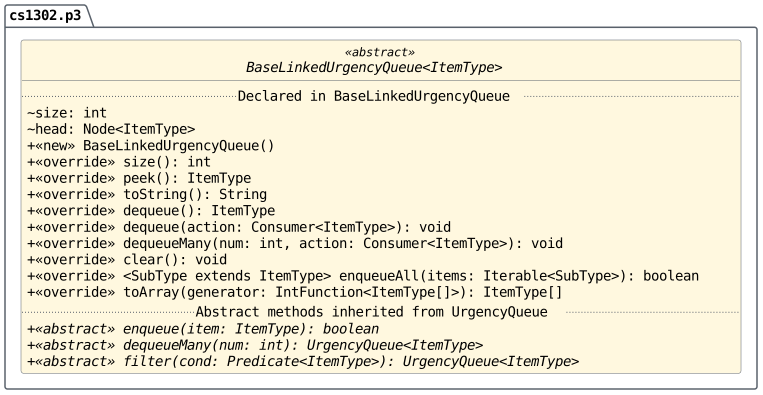
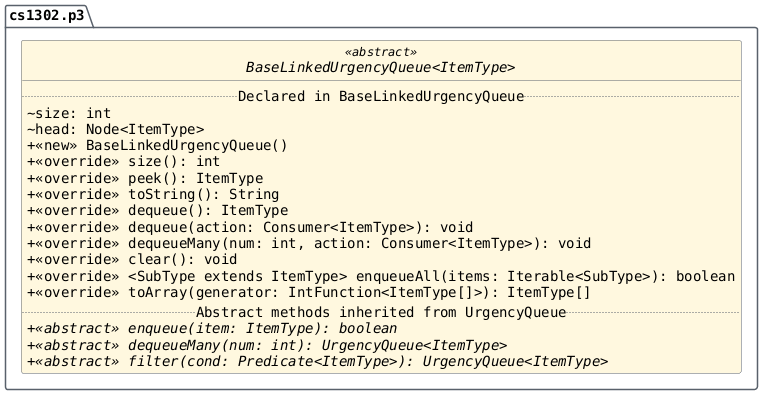
Implement the methods listed as declared in this class according to the
UrgencyQueue interface contract. The remaining abstract operations are implemented
in the concrete subclasses. Shared operations must work for either
ordering policy and must not depend on a concrete child class. Use the
existing interface operations when one shared operation needs behavior
supplied by a concrete queue.
The base constructor establishes the empty state. Throughout normal
operation, size must agree with the number of reachable item nodes.
For an empty queue, head has the value null. For a nonempty
queue, head refers to the first node, which stores the most urgent
item's reference value. Following the next-node reference values reaches
the remaining items in urgency order and eventually a node whose
next value is null.
cs1302.p3.LinkedUrgencyQueue
Implement LinkedUrgencyQueue in src/cs1302/p3/LinkedUrgencyQueue.java with type
parameter ItemType extends Comparable<ItemType> and parent class
BaseLinkedUrgencyQueue<ItemType>. Its public no-argument constructor
initializes an empty queue through the base constructor.
Fig. 3.6 The natural-order queue's declarations and relevant members inherited from the shared base. [svg] [png]
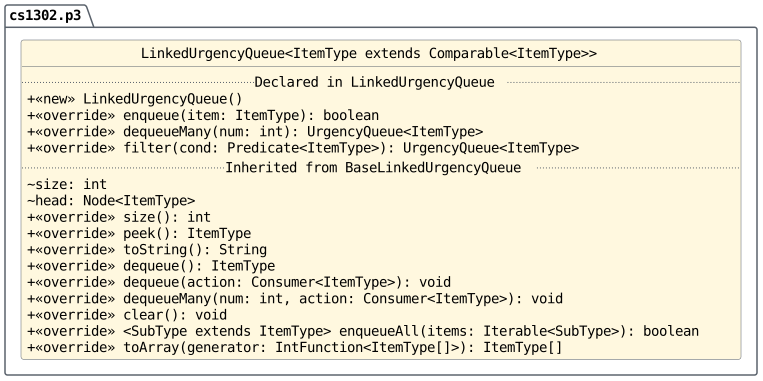
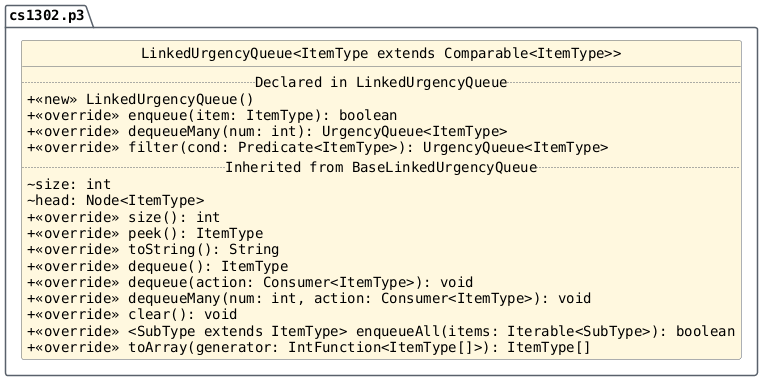
Implement enqueue, dequeueMany(int), and filter
in this class. Compare items using their natural ordering and preserve
FIFO order for equal urgency. The queue result produced by either of
the latter two methods must be a new LinkedUrgencyQueue object with the same item
type. Preserve the distinction between filtering without modifying the
calling queue and dequeuing items from that queue.
The provided Person class
implements Comparable<Person>. You can therefore write tests
for UrgencyQueue<Person> using an
OracleLinkedUrgencyQueue<Person> object immediately, then run
those same tests using a LinkedUrgencyQueue<Person> object
once you have implemented the class. Refer to the
OracleLinkedUrgencyQueue API documentation for the provided
implementation, whose type parameter is declared as
ItemType extends Comparable<ItemType>.
Important
The provided Person class is used in examples throughout the
project's API documentation. These are runnable examples, not merely
theoretical illustrations. You can run them right now by placing the
example statements in the main method of a driver or tester class,
adding the required imports, and compiling and running the class with
cs1302-urgency-queue.jar on the classpath. You do not need to finish your queue
implementation before trying examples that use the provided oracle.
cs1302.p3.CustomLinkedUrgencyQueue
Implement CustomLinkedUrgencyQueue in src/cs1302/p3/CustomLinkedUrgencyQueue.java with
type parameter ItemType and parent class
BaseLinkedUrgencyQueue<ItemType>. Declare a private
Comparator<ItemType> field named comparator. Its public
constructor accepts that comparator, rejects null with
NullPointerException, and initializes an empty queue.
Fig. 3.7 The custom-order queue's declarations, its own comparator field, and relevant members inherited from the shared base. [svg] [png]
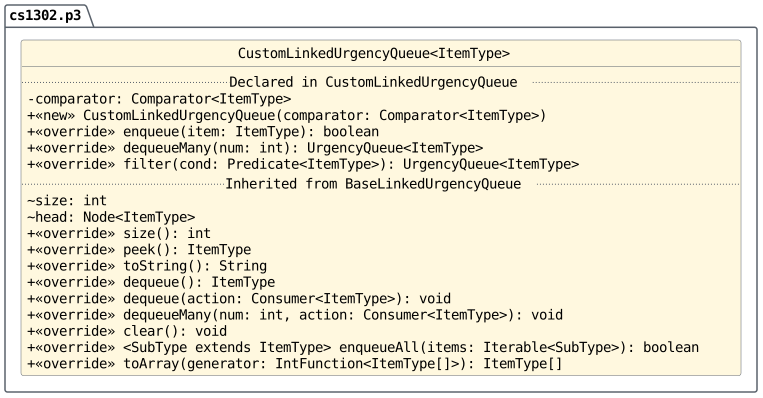
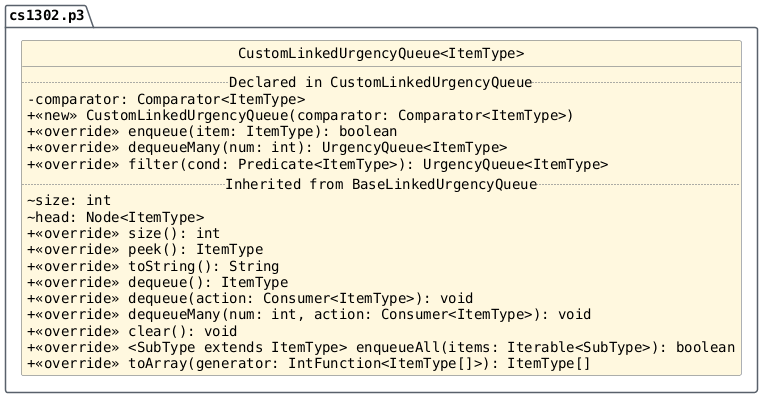
Implement enqueue, dequeueMany(int), and filter
using the supplied comparator's ordering. Preserve FIFO order for equal
urgency. Both queue-producing methods must create a new CustomLinkedUrgencyQueue object
that uses the same comparator. Copying that reference value does not
copy the comparator object. The custom queue does not impose a
Comparable upper bound on its class type parameter.
You can use the provided Movie class
and Person class
to write tests for UrgencyQueue<Movie> or
UrgencyQueue<Person>, using an
OracleCustomLinkedUrgencyQueue<Movie> object or an
OracleCustomLinkedUrgencyQueue<Person> object, respectively.
Refer to the OracleCustomLinkedUrgencyQueue API documentation for this provided implementation. Its type parameter is
ItemType, with no explicit Comparable upper bound.
Supply a comparator to each queue constructor. You can create your own
comparators by writing concrete classes that implement
Comparator<Movie> or Comparator<Person>, or by using
lambda expressions. You can also use the comparators provided by the
methods in Movie.Order
and Person.Order,
respectively. Once you have implemented CustomLinkedUrgencyQueue, run the same tests
using your implementation with the same comparators.
Important
The provided Movie and Person classes are used in examples
throughout the project's API documentation. These are runnable
examples, not merely theoretical illustrations. You can run them right
now by placing the example statements in the main method of a
driver or tester class, adding the required imports, and compiling and
running the class with cs1302-urgency-queue.jar on the classpath. You do not need
to finish your queue implementation before trying examples that use
the provided oracle.
Hidden Test Cases (100 points)
The bulk of your grade will be derived from functional test cases executed against your compiled classes by our automated test suite on Odin. These tests will verify:
Correct insertion ordering in
enqueueaccording to natural (Comparable) and custom (Comparator) orderings.Correct FIFO tie-breaking for items of equal urgency.
Proper tracking of queue
size()and empty state.Correct values returned and removed by
peek(),dequeue(), anddequeueMany().Correct behavior of functional methods (
filter,dequeue(Consumer),dequeueMany(int, Consumer)).The method type parameter
SubType extends ItemTypeinenqueueAlland correct array generation and item ordering intoArray.Strict adherence to exception-throwing specifications (e.g.,
NullPointerException,IllegalStateException,IllegalArgumentException).
3.6. Non-Functional Requirements
A non-functional requirement specifies criteria that can be used to judge your submission independently from its function or behavior. If functional requirements describe what your submission should do, then the non-functional requirements describe how your submission is supposed to be. If your submission does not satisfy a non-functional requirement listed in this section, then the requirement's point total is deducted from your submission grade.
Missing Parts (45 points)
You are expected to submit all three parts of this project as described elsewhere in this document. 15 points will be subtracted from your earned point total for each missing part, up to a maximum deduction of 45 points.
Environment and Structure (100 points)
This project targets Java 25 and must compile and run correctly on Odin using JDK 25. Your directory structure and package structure should match the structure of the starter code.
The source root must be a direct subdirectory of
cs1302-urgency-queuenamedsrc. Place package directories beneath this source root.The only
.javafiles that you should include areBaseLinkedUrgencyQueue.java,LinkedUrgencyQueue.java,CustomLinkedUrgencyQueue.java, andQueueTester.java(as well as the.javafiles for any child classes ofQueueTesterthat you create, if applicable).The
BaseLinkedUrgencyQueue.java,LinkedUrgencyQueue.java,CustomLinkedUrgencyQueue.java, andQueueTester.javafiles (as well as the.javafiles for any child classes ofQueueTesterthat you create, if applicable) are expected to compile without any errors or warnings on Odin using:javac --release 25 -d bin -cp cs1302-urgency-queue.jar \ -Xlint:rawtypes -Xlint:unchecked -Werror \ src/cs1302/p3/*.java src/cs1302/test/*.java
The compiled class root must be a subdirectory of
cs1302-urgency-queuenamedbin. The compilation command creates package directories beneath it.If you include compiled code with your submission, then it will be ignored. Graders are instructed to recompile your submission on Odin before testing your submission.
The location of your generated API documentation website files should be a sub-directory of
cs1302-urgency-queuecalleddoc.See the API Documentation Website non-functional requirement for more information about what should be in the
docdirectory.
If a problem is encountered for your submission that is explicitly described above, then 100 points will be subtracted from your earned point total; however, if the problem is compilation-related or structure-related and NOT explicitly described above, then it will be handled on an individual basis.
Code Style (20 points)
Every .java file that you include as part of your submission
for this project must be in valid style as defined in the CS1302
Code Style Guide. All of the
individual code style guidelines listed in the style guide document
are considered for this requirement.
If check1302 on Odin reports any style violations for your submission, then 5 points will be subtracted from your earned point total for each violation, up to a maximum deduction of 20 points.
API Documentation Website (5 points)
Generate the API documentation website for all of the code in the
cs1302.test and cs1302.p3 packages into a directory named
doc directly inside your cs1302-urgency-queue directory, then host the
documentation on Odin using cs1302-urgency-queue-doc as the name
for your symbolic link. Instructions describing how to do both of those
things are provided in the Javadoc and API Documentation chapter.
Assuming you are directly inside your cs1302-urgency-queue directory, the
command below can be used to generate the website files and
place them in the doc directory:
javadoc --release 25 -d doc \
    -cp cs1302-urgency-queue.jar \
    -sourcepath src \
    -subpackages cs1302
To host the API documentation website so that it is accessible via
your Webwork URL, create a symbolic link to your project's doc
directory at ~/public_html/cs1302-urgency-queue-doc using the ln
command by adapting the instructions in Hosting the API Documentation Website. You only need to create the
symbolic link once, assuming you create it correctly.
If your doc directory is missing OR does not contain the
appropriate files, then 5 points will be subtracted
from your earned point total. This will be checked for each
part, so make sure to double check your doc directory and the
generated website to make sure they are up to date prior to
submitting each part of the project.
SUBMISSION.md (5 points)
Create or update the file named SUBMISSION.md inside the cs1302-urgency-queue
directory to include the following information:
Your name and UGA ID number; and
The full link to the API documentation website that you generated and hosted to satisfy the related non-functional requirement stated earlier.
Create this file yourself; it is not supplied in the starter code. For example:
Sally Smith (811-000-999)
https://webwork.cs.uga.edu/~user/cs1302-urgency-queue-doc
Be sure to modify the contents of SUBMISSION.md with your
information. Although the file extension is .md, the
SUBMISSION.md file is just a plain text file that you can edit
with a text editor like Emacs.
If your SUBMISSION.md file is missing OR does not contain the
appropriate information, then 5 points will be
subtracted from your earned point total. This will be checked for
each part, so make sure to double check your SUBMISSION.md
file prior to submitting each part of the project.
Git Commit Log (15 points)
The files in your project submission must be under version control and fully committed using Git, and your Git commit log should indicate progress since the project was assigned or since the last part was due, whichever is more recent.
Each part of the project requires you to make several commits, so this shouldn't be a problem so long as you are following the instructions in the Project Checklist.
If no such progress is indicated via your commit log, then 5 points will be subtracted from your earned point total for each applicable part, up to a maximum deduction of 15 points.
Node Sequence Storage (100 points)
You must use a singly linked chain of Node<ItemType> objects for the internal
storage of items in your queue implementations. Unlike an array-based
implementation, this type of storage is not limited to a fixed capacity
(because there is no underlying array); instead, it is limited only by
the available memory for the Java program using the urgency queue object.
If you use Java's java.util.LinkedList class,
java.util.ArrayList, java.util.PriorityQueue, or
something similar (e.g., any class that implements
java.util.Collection), then that will result in an immediate
violation of this non-functional requirement, regardless of any use of
Node objects elsewhere in the class. This requirement also prohibits
any use of third-party implementations of list- or queue-like data structures.
No Implementation Dependencies (100 points)
You are not permitted to use one implementation of the UrgencyQueue<ItemType> interface
in another implementation. For example, you cannot use the CustomLinkedUrgencyQueue class
inside of your LinkedUrgencyQueue class or vice versa. Additionally, BaseLinkedUrgencyQueue cannot
depend on either of its child implementations; however, it can (and
should) depend on the UrgencyQueue<ItemType> interface itself. If you have any questions
about this, then please ask your instructor.
From the project root, compile first:
./compile.sh
Then inspect class dependencies:
jdeps -v -cp cs1302-urgency-queue.jar bin
In the output, A -> B means that class A depends on type B.
These abbreviated examples illustrate permitted dependencies:
cs1302.p3.LinkedUrgencyQueue       -> cs1302.p3.BaseLinkedUrgencyQueue
cs1302.p3.BaseLinkedUrgencyQueue   -> cs1302.gen.UrgencyQueue
cs1302.p3.BaseLinkedUrgencyQueue   -> cs1302.gen.Node
cs1302.p3.CustomLinkedUrgencyQueue -> java.util.Comparator
cs1302.test.QueueTester           -> cs1302.p3.LinkedUrgencyQueue
These dependencies violate the implementation or library restrictions:
cs1302.p3.LinkedUrgencyQueue       -> cs1302.p3.CustomLinkedUrgencyQueue
cs1302.p3.CustomLinkedUrgencyQueue -> cs1302.p3.LinkedUrgencyQueue
cs1302.p3.BaseLinkedUrgencyQueue   -> cs1302.p3.LinkedUrgencyQueue
cs1302.p3.BaseLinkedUrgencyQueue   -> cs1302.oracle.OracleLinkedUrgencyQueue
cs1302.p3.LinkedUrgencyQueue       -> java.util.Arrays
cs1302.p3.LinkedUrgencyQueue       -> java.util.PriorityQueue
The tester is allowed to depend on concrete student classes and oracle classes so that its construction hook can select them. The restriction applies to dependencies between queue implementations, not to those testing dependencies.
jdeps reports dependencies on classes, not individual method
calls. A dependency on System does not identify whether your code
calls System.arraycopy, and an array's clone() call need
not appear as a distinctive class dependency. Inspect your source for
those prohibited calls as well as inspecting the dependency report.
No java.util.Arrays Dependencies (or similar; 100 points)
You are also NOT allowed to use the java.util.Arrays class.
You can also check for the presence of this dependency using
jdeps as described in an earlier requirement — you don't want
to see java.util.Arrays anywhere in the output. The
System.arraycopy method and the array clone() method are
also not allowed for similar reasons. You can use C-s and
C-r in Emacs to search your source files for any occurrences of
these prohibited methods.
3.7. Submission Instructions
You will submit each part of your project on Odin from the parent
directory of your cs1302-urgency-queue repository.
How to Submit
From inside
cs1302-urgency-queue, run the providedcompile.shscript to compile, check style, and regenerate documentation:./compile.sh
Run the applicable tests described in Compile, Test, and Retest. For Parts 2 and 3, require the completed implementation's tests to pass. For Part 1, distinguish the passing oracle checks from expected student stub failures.
Verify that
docis current and that its hosted website works.Verify
SUBMISSION.mdhas been updated.Ensure your work is staged and committed using git:
git statusgit add src/ doc/ SUBMISSION.md git commit -m "..."
Change to the directory immediately above
cs1302-urgency-queueand execute the submission command for the part you are submitting:cd ..
submit1302 cs1302-urgency-queue partNReplace
partNwithpart1,part2, orpart3.Verify that a receipt file beginning with
rechas been placed inside yourcs1302-urgency-queuedirectory.
3.8. Frequently Asked Questions
What is an Urgency Queue?
An urgency queue is a collection that stores elements where each item has an associated priority or urgency. Unlike a standard FIFO queue where elements are dequeued in the order they arrived, an urgency queue always serves the most urgent item first. In this project, when two items have the same urgency, the tie is broken using FIFO order (the item enqueued earlier is dequeued first).
How do I test for expected exceptions?
Follow the exception type documented for the method and situation being
tested. For example, when queue refers to an empty urgency queue,
dequeue() must complete abruptly with
IllegalStateException:
try {
    queue.dequeue();
    throw new AssertionError("Expected IllegalStateException");
} catch (IllegalStateException expected) {
    // The required exception was thrown.
} // try
If the method call completes normally, the assertion fails. A different
exception escapes this catch clause and fails the test. For
dequeueMany, test negative counts and counts greater than the
queue's size separately because their required exception types differ.
For an operation required to leave the queue unchanged on failure, also
compare its state before and after the call.
Why can't I use java.util.Arrays?
The purpose of this assignment is to develop your understanding of
fundamental data structures, reference manipulation, and algorithms
from first principles. Using utility libraries like
java.util.Arrays circumvents the core learning objectives of
the course.